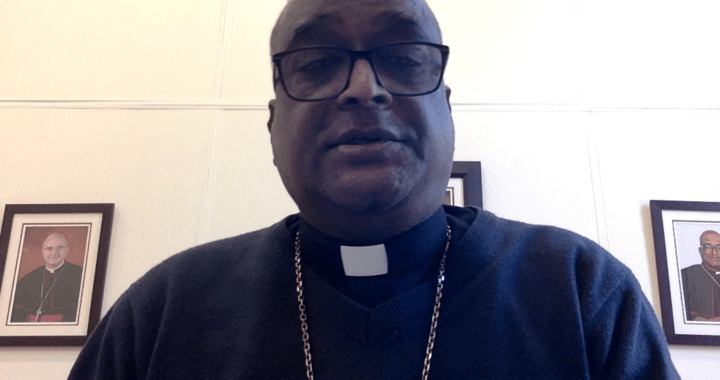
Prayer and Reflection by Bishop Sylvester David OMI

Auxiliary Bishop Sylvester David offers his prayer and reflection for the people of the Archdiocese of Cape Town for today, Friday 5 November 2021, during this time of the Coronavirus pandemic. It is also available on the Archdiocese of Cape Town’s Facebook page and YouTube channel. Please also see below the text of his reflection, primarily for the deaf.

Friday 5 November 2021

Again, we honour this time of the Synod by praying the Adsumus prayer:

We stand before You, Holy Spirit,
as we gather together in Your name. 

With You alone to guide us,
make Yourself at home in our hearts; 

Teach us the way we must go
and how we are to pursue it. 

We are weak and sinful;
do not let us promote disorder.

Do not let ignorance lead us down the wrong path nor partiality influence our actions. 

Let us find in You our unity
so that we may journey together to eternal life and not stray from the way of truth
and what is right. 

All this we ask of You, who are at work in every place and time, in the communion of the Father and the Son, forever and ever. Amen. 

Perhaps, just to recap – Adsumus is a Latin term meaning a coming together. It conveys the notion of God’s people coming together in response to the call of the Spirit.

Reflection: Romans 15:14-21 and Psalm 97

Both the first reading and the Responsorial Psalm for today’s Mass articulate God’s desire for inclusivity. Paul insists that his mission is to preach to people who have not known of Christ. Although this situation, with a few exceptions, is less likely after more than twenty centuries of Christian existence, we can still locate numerous people who might have heard of Christ but have not felt his love and support simply because Christians have failed to demonstrate these qualities. This happens when we are Christians in name only and not in our lifestyles, our choices and our responses.

Perhaps a real story can help us: Many years ago I went to meet a friend who lived in a block of flats. We had planned to go to a cinema. While walking towards the stairs of the apartment block, we heard a child scream in agony. He asked me to wait for a few minutes and he knocked at the door where the commotion was coming from and said quite clearly to the woman who was beating the child that he would report her to the authorities if she did not stop abusing the child. She was his neighbour and he had repeatedly heard the effects of the child being beaten. She was stunned and after a few moments burst into tears. I found out later that his intervention had a very positive outcome. He followed it up and got that family the necessary help – both for the mother and the child. When I commended my friend for that he said that he simply did his duty as a Muslim. This is not the only time he spoke out against unfairness. He made his religion attractive as a voice in favour of the helpless. Sadly, as in our own faith, there are also many examples of religion conveying less than noble intentions.

Is it the function of religion to turn a blind eye to the suffering and victimisation of helpless people? Jesus answered this question in Mt 11:22-24 when he accused Bethsaida and Chorazin of not having converted. He makes an unfavourable comparison between these towns and the infamous Sodom and Gomorrah. The citizens of Bethsaida and Chorazin could rightly stand up and protest: “But Jesus, we did nothing” and he will say: “That’s exactly the problem – you did nothing!” Christianity is not only about avoiding evil – it is about actively doing good. This is why the Synod with its call for inclusivity is so important. It reminds us that we are not to exclude people who do not talk like us, worship like us, eat like us and dress like we do. Like my friend who heard the cry of a little one and brought about a positive change to his neighbour’s home, let’s see what we can do by standing up for the unrepresented, by speaking the kind word, by showing gratitude, etc. As the Statesman and Philosopher Edmund Burke (died 1797) noted: “evil thrives where good people do nothing”. 

There is a saying: “Charity begins at home”. Perhaps before we venture out into the neighbourhood, it will be good to take the momentum of the Synod into our own homes and listen to the various voices which comprise our home. There are people, especially the old and infirm, who are affirmed for not complaining – but when someone takes a real interest in them, real needs and aspirations are articulated. They do not complain simply because they have been conditioned not to. Sometimes it goes beyond using just the ears as some situations simply call us to be more attentive. For example a plant wilting in its dry pot ought to be listened to and given water otherwise it will die. An inactive pet could be communicating that it needs attention. Parents seem to have an instinct for this when their children need attention. Let’s see how we can practice greater attentiveness in the home so that we can live in more Christ-centred places. 

In all of this let us remember the saying of St Teresa of Avila that “Christ has no body now but yours. No hands, no feet on earth but yours. Yours are the eyes through which he looks compassion on this world. Yours are the feet with which he walks to do good. Yours are the hands through which he blesses all the world. Yours are the hands, yours are the feet, yours are the eyes, you are his body. Christ has no body now on earth but yours.”

Let us pray: Father you bless us with many opportunities to imitate your own merciful attitude. You take care of us, of the flowers in the field, and of the birds of the air. Help us to imitate your love and care more and more, starting in our homes and reaching out to all creation. We ask this through Christ our Lord. Amen.

Bishop S. David OMI 
VG/Auxiliary Bishop – Cape Town

Prayer and Reflection by Archbishop Stephen Brislin

Archbishop Stephen Brislin offers his prayer and reflection for the people of the Archdiocese of Cape Town for today, Wednesday 3 November 2021, during this time of the coronavirus pandemic. It is also available on the Archdiocese of Cape Town’s Facebook page and YouTube channel. Please also see below the text of his reflection, primarily for the deaf.

Welcome to today’s reflection. I hope that all those who were eligible to vote in the local elections were able to do so. As we begin the month of November, we remember the faithful departed and pray for them that the Lord, in his mercy, will grant them eternal life. We begin this reflection with the Adsumus prayer, praying for the Synod of 2023:

We stand before You, Holy Spirit,
as we gather together in Your name. 

With You alone to guide us,
make Yourself at home in our hearts; 

Teach us the way we must go
and how we are to pursue it. 

We are weak and sinful;
do not let us promote disorder.
Do not let ignorance lead us down the wrong path nor partiality influence our actions. 

Let us find in You our unity
so that we may journey together to eternal life and not stray from the way of truth
and what is right. 

All this we ask of You,
who are at work in every place and time,
in the communion of the Father and the Son, forever and ever. Amen. 

The Scripture reading is from the Gospel of today’s Mass (Luke 14:25-33):

And indeed, which of you here, intending to build a tower, would not first sit down and work out the cost to see if he had enough to complete it?”

There is a cost to being a disciple of Jesus Christ. It is not simply calling ourselves Christians that makes us Christians. If we are really intent on following Jesus, there are consequences to that decision. We have to think carefully and question whether we have the resources to persevere in the path to which we have been called and chosen – just as a person who has decided to build a tower needs to think about whether he will be able to complete building it, and to assess what will be needed to accomplish the task. If not, he will land up with a half-built tower and will have wasted everything, including his self-esteem.

In our own reckoning of our ability to follow the Lord, we have to look at both our inner resources and outer resources. In the inward journey – and St Augustine has taught us, based on his own experience, that we find God within ourselves – we have first and foremost to look at our faith. Faith is a gift given by God, but it is also a gift that must be nurtured. Ultimately, true faith comes through an encounter with God, an awareness of his presence within us and in the world. It is about trust in God’s providence and care for us. We could perhaps sum it up with the question, is God real for me. We know that God is both transcendent (that is, God is above and beyond the normal and physical level), and he is also immanent (that is, indwelling and manifested in the material world). It is only when we have experienced, in a personal way, the mystery of God both as far beyond us and yet closely with us, that we are drawn in a hungry fascination and wonder to grow closer and closer to him. In allowing ourselves to be drawn by God, expressed by the Prophet Jeremiah in these words: you seduced me and I let myself be seduced by you (Jer 20:7), we have to question whether we have the ability to persevere and be faithful. The way to God is the road to peace, contentment and growth, but it is also a road that demands the endurance of suffering. As Jesus warns in the Gospel passage of today’s Mass,anyone who does not carry his cross and come after me cannot be my disciple. In short, it involves a total self-giving, of offering oneself to God. Thus Jesus also says, none of you can be my disciple unless he give up all his possessions. Ultimately, it is not a matter of only giving up material possessions but of given up one’s self and will so that his will may be done.

We have also to consider our ability to love. We cannot love God while ignoring our neighbour – as St John says, If anyone says, “I love God,” yet hates his brother, he is a liar. For anyone who does not love his brother, whom he has seen, cannot love God, whom he has not seen (1Jn 4:20)It is through our neighbour that we love God, for our neighbour is created in the image of God and, in some way, God dwells in his/her heart. Relationships can be fraught with friction, personality differences, hurt and sin. Part of carrying our cross must also be to carry each other’s burdens (Gal 6:2) and short-comings. It is through our neighbour that we learn to forgive, to tolerate, to accept and to reconcile. It is our neighbour who “mellows” us and helps us change into better people and better Christians. Difficult people can make us better people and more Christ-like. In all of our relationships, we are conscious of the great ideal of Christ’s teaching – to forgive. God is not only just but also merciful, and we must be the same. Peace is the fruit of love, because love goes beyond what justice can provide.1 Our aim must always be to reconcile and to restore relationships, and so we have to let go of a lot of “possessions” – the possessions of pride, hurt, self-righteousness, self-aggrievement and the desire to get satisfaction for wrongs we have endured. 

In assessing the outer resources necessary to be disciples, we look particularly at our relationship with the Church founded by Christ who gathered together those who wished to follow him. We consider and assess our participation and unity with the Christian community. It is in that oneness of belonging to the believing community, in coming together as community in prayer and worship, in receiving the Sacraments and the grace mediated through the Church, and playing our part through participation in building up the Christian community, that we receive the strength and courage from the very fountain of life and grace, Jesus Christ. We cannot meet the “cost of discipleship” unless we have the support that flows from belonging to the Body of Christ, the Christian family. But this is not a “one-way street”. We too must play our part in learning more and more to love the Church and to give ourselves in service to God through the Church.

Let us now close with a prayer:

Loving Father, we commend to you all the souls of the faithful departed, especially our loved ones and the forgotten ones. Be merciful to them Lord, and allow them a share in your glory. Through Christ, our Lord, amen. 

The Lord be with you: And with your spirit.

May Almighty God bless you, the Father, the Son and the Holy Spirit, amen.

1Constitution of the Second Vatican Council on the Church in the Modern World N78

Prayer and Reflection by Bishop Sylvester David OMI

Auxiliary Bishop Sylvester David offers his prayer and reflection for the people of the Archdiocese of Cape Town for today, Friday 29 October 2021, during this time of the Coronavirus pandemic. It is also available on the Archdiocese of Cape Town’s Facebook page and YouTube channel. Please also see below the text of his reflection, primarily for the deaf.

We honour this time of the Synod by praying the Adsumus prayer:

We stand before You, Holy Spirit,
as we gather together in Your name. 

With You alone to guide us,
make Yourself at home in our hearts; 

Teach us the way we must go
and how we are to pursue it. 

We are weak and sinful;
do not let us promote disorder.

Do not let ignorance lead us down the wrong path nor partiality influence our actions. 

Let us find in You our unity
so that we may journey together to eternal life and not stray from the way of truth
and what is right. 

All this we ask of You, who are at work in every place and time, in the communion of the Father and the Son, forever and ever. Amen. 

Is it against the law to cure a man on the sabbath? Lk 14:1-6

“Now on a sabbath day Jesus had gone for a meal to the house of one of the leading Pharisees; and they watched him closely. There in front of him was a man with dropsy, and Jesus addressed the lawyers and Pharisees. ‘Is it against the law’ he asked ‘to cure a man on the sabbath, or not?’ But they remained silent, so he took the man and cured him and sent him away. Then he said to them, ‘Which of you here, if his son falls into a well, or his ox, will not pull him out on a sabbath day without hesitation?’ And to this they could find no answer” (Lk 14:1-6).

First an explanation of the attitude of the Pharisees. We are told that they “watched” Jesus closely. The word used indicates extreme hostility. They looked at Jesus with disdain and wanted to trap him, and in so doing, opposed the works of God.

Reflection

When conducting an Ignatian retreat, retreat masters often ask retreatants to enter into the scene. Miracle stories can be fruitfully encountered in this fashion and can tell us a lot about ourselves. The idea is to identify oneself with any of the characters in the text, or even to see that many of the characters show us aspects of ourselves e.g. in the Mary and Martha story (Lk 10:38-42) one can identify with either of the sisters, or one can see the attitudes of both in oneself. In the story for today one can identify with the man who was in need, with the Pharisees, or with Jesus. Let’s take them one at a time. 

The man in need had a painful condition which caused his body to retain water. This was often a sign of a heart problem. In identifying with this man, I need to see my need. What is it that makes me disabled and helpless? Water retention (dropsy) might not be my particular issue but what is it that prevents me from having a fuller life? It could be an aspect of my social or family relationships. It could be a dependence on alcohol, or it could be a need for forgiveness. Illness comes in many forms and the most dangerous ones are the invisible ones such as being trapped in a cycle of anxiety and depression, or enduring an abusive relationship.

It is possible that this man was planted “in front of” (Lk 14:2) Jesus quite deliberately in order to see what he would do on the sabbath. There are numerous disputes that they had with Jesus regarding the sabbath (cf. Lk 4:38; 6:6; 13:13). Planting a needy man “in front of” Jesus is not as far fetched as it might sound because of the hostility shown to Jesus by their subversive monitoring of him as shown in the first verse of the passage. Do I allow myself to be used for purposes which are destructive? This can happen when I participate in negative conversations about others, or when I take delight in their misfortune.

The second possibility for character identification is the group called “lawyers and Pharisees” (Lk 14:3) in this passage. These people were hostile to Jesus. They were so hell bent on keeping the letter of the law that they forgot about the spirit of the law. They knew the catechism of their day but failed to recognise the Messiah who was lord of the sabbath (Lk 6:5). Above all, they made a mockery of their religion by failing to show mercy. Am I like that, with full knowledge of the rubrics but without mercy? The prophets raged about the practice of religion which did not incorporate mercy. Is 58:1-12 is a case in point. Amos 4:1-3 and 5:21-27 are other examples. These people liked to find fault but instead of looking into the mirror at themselves, they looked at others through their microscopes.

The third position is that of Jesus who acted with compassion. The result was that the suffering man was restored. Recently Covid has shown us many such people. These are medical workers, people who ensure that the poor are fed and many other persons of goodwill who routinely bring life to others. Am I counted among them? It is not difficult to make people feel better about themselves. Even a kind word of thanks to those who serve and work at supermarket checkout points can help bring a human face to the space occupied by human beings. 

Let us pray: Father, our current struggle presents us with the raw materials from which our Christian responses are fashioned. Help us to imitate your Son more closely in all we do and say so that we may worship you in spirit and in truth. We ask this through Christ our Lord. Amen.

Prayer and Reflection by Archbishop Stephen Brislin

Archbishop Stephen Brislin offers his prayer and reflection for the people of the Archdiocese of Cape Town for today, Wednesday 27 October 2021, during this time of the coronavirus pandemic. It is also available on the Archdiocese of Cape Town’s Facebook page and YouTube channel. Please also see below the text of his reflection, primarily for the deaf.

Welcome to today’s reflection. In these last few days before the local elections, let us pray that they will be conducted peacefully and without incident. We also remember to pray for peace in eSwatini:

O God of justice and love, bless us, the people of Southern Africa,
and help us to live in your peace.

Lord, make me an instrument of your peace:
Where there is hatred, let me sow love;
Where there is injury; let me sow pardon;
Where there is discord, let me sow harmony.

Divine Master, grant that I may not so much
Seek to be understood, as to understand;
To be loved, as to love;
To receive sympathy, as to give it;

For it is in giving that we shall receive,
In pardoning that we shall be pardoned,
In forgetting ourselves that we shall find
Unending peace with others. We ask this through Christ Our Lord, Amen.

The Scripture verses comes for the First Reading of today’s Mass (Romans 8:26-30)

Likewise the Spirit helps us in our weakness; for we do not know how to pray as we ought, but the Spirit himself intercedes for us with sighs too deep for words. And he who searches the hearts of men knows what is the mind of the Spirit, because the Spirit intercedes for the saints according to the will of God.

At the moment, apart from the book I am using in my morning meditation, I am reading a historical novel on the emperor Constantine and his times. It gives a historical account and yet also enlightens life in the present. There are two things which have struck me particularly (not for the first time, but they have brought home to me these realities again).

Firstly, I am reminded that we are not only products of history, but we are part of history. In the words of Isaac Newton, If I have seen further it is by standing on the shoulders of Giants. The saying, in one form or another, probably goes back to the 12th Century, but it captures the idea that we are who we are because of those who went before us, and that what we achieve is simply building on what others have achieved – in short there is progress in the world in terms of ideas and understanding – it can be referred to as gradualism. Of course, this does not rule out that there can also be regression rather than progress! The point is that we are all links in this historical chain, uniting us right back to the very beginnings creation and with the future culminating in the final eschaton, the accomplishment of the Kingdom of God. This is an awesome and humbling reality, as well as an awesome responsibility because we shape not only the present but also the future. Knowing that we have a role both of building positively on the past and of responsibly paving the way for the future, should change how we understand life and its purpose.

The second reminder I’ve had is that much of “real history” gets lost in the recitation of major historical events to the neglect of the many minor events over many years which led up to those momentous moments and helped form them. For example, we all know something of the history of Constantine and how he changed the course of our Christian faith by ending the persecution of Christians by the Roman Empire and establishing Christianity as the official religion. A historical novel tries to fill in the gaps of the history of events describing, even albeit in a speculative way, what has formed and caused people to act in the way they did, the influences they experienced in their lives going back even to childhood. While these may not be historically accurate, what is for sure is that decisions and actions do not just happen out of the blue. In our Christian understanding we see all these formative events, many of them small, as the movement and working of God’s Holy Spirit. Both great and small events unfold the history of salvation. We can see it also in terms of how Christians – saints, theologians, martyrs – have influenced not only Christian life and teaching but also on culture and world events. For example, how their teaching and witness has built on and made concrete the Scriptures in terms of the dignity of the human person, on human rights, on the meaning and purpose of life . Their impact has extended far beyond the audiences they were writing for, and far beyond the Christian faith itself. We too should know that every small deed of goodness and kindness has its influence.

The point I’m trying to make takes us back to the Scripture verses I read at the beginning which refer to the Holy Spirit whose “sighs are too deep for words” and who “searches the hearts of men”. The real history of the ages, of the present and of the future, is in God’s Holy Spirit working through nature, through ordinary everyday events, through touching and transforming the hearts of individuals, through creating the desire, the thirst, for human completeness and fulfilment. We know the events of history, the speeches, the actions that have brought about changes in the direction of the world. What we do not often see or recognize is the silent, ever-present action of God’s Spirit that has always been, and continues to guide, to lead and to create. As is written in Psalm 19(3), There is no speech, nor are there words; their voice is not heard; yet their voice goes out through all the earth. Even in the most chaotic times, God’s Spirit is present and moving, as the world is guided to its final destination. How glorious this is, and how privileged we are, to be part of this global and universal , unseen and unheard, movement of the Spirit which we recognise and know through Christ’s promise to us “I will be with you until the end of time” (Matthew 28:20).

Before we make our “X” on the ballot paper when we vote next week (and it is our duty to vote), let us pray that the Holy Spirit will give us the “mind of God” to make the best choice possible that will serve the growth of God’s Kingdom. Let us now pray for God’s blessing:

The Lord be with you R/ And with your Spirit

Bow down for the blessing:

Father, look kindly on your people that they may always have the mind of God. May they always be encouraged by the knowledge of your Holy Spirit working in the world, and open their hearts to always co-operate with your Spirit. Through Christ, our Lord, amen. May Almighty God bless you, the Father, the Son and the Holy Spirit, amen.

Prayer and Reflection by Archbishop Stephen Brislin

Archbishop Stephen Brislin offers his prayer and reflection for the people of the Archdiocese of Cape Town for today, Wednesday 20 October 2021, during this time of the coronavirus pandemic. It is also available on the Archdiocese of Cape Town’s Facebook page and YouTube channel. Please also see below the text of his reflection, primarily for the deaf.

Welcome to today’s reflection. On Sunday, we launched the preparation phase for the 2023 Synod on Synodality. In the coming months we will reflect on various matters of importance to the life of the Church in these times, bearing in mind the main themes of communion, participation and mission. We will be praying the synod prayer in every parish. However, we should not forget also to pray for peace in Southern Africa, especially in this period before the local elections. And so I will be alternating the prayers in the coming weeks. Let us pray the Adsumus Prayer of the Synod :

We stand before You, Holy Spirit,
as we gather together in Your name. 

With You alone to guide us,
make Yourself at home in our hearts; 

Teach us the way we must go
and how we are to pursue it. 

We are weak and sinful;
do not let us promote disorder.
Do not let ignorance lead us down the wrong path nor partiality influence our actions. 

Let us find in You our unity
so that we may journey together to eternal life and not stray from the way of truth
and what is right. 

All this we ask of You,
who are at work in every place and time,
in the communion of the Father and the Son, forever and ever. Amen. 

The Scripture reading is an excerpt from the First Reading of today’s Mass, from St Paul’s letter to the Romans (Rom 6:12-18):

You were once slaves of sin, but thank God you submitted without reservation to the creed you were taught. You may have been freed from the slavery of sin, but only to become ‘slaves’ of righteousness.

Over the past weeks I have been speaking of sin, the necessity for repentance leading to conversion, and the “putting on the new man” (cf. Ephesians 4:22-24). This teaching is central to the Scriptures – both Old and New Testaments. Nonetheless, we should not forget that Christianity is not so much about not doing something, and is more about what we do. And so, in the Reading we have just heard, St Paul says that we have become slaves to righteousness. He also says, we live by grace and not by law, and we should make every part of our body a weapon for fighting on the side of God. As Christians we desire to live righteous lives. Of course, we should distinguish between self-righteousness, which has the negative connotation of making oneself the final moral arbitrator, and righteousness which acknowledges God as the arbitrator of what is right and wrong. Righteousness always embraces compassion.

We are called to do what is right. That’s an easy statement to make, but its implications are not always that easy. Some things are clear, both in terms of our faith but also common to all humanity – you shouldn’t murder people, for example. Others are clear in terms of our faith but not necessarily common to humanity – keep the Sabbath holy, is an example. Most of life, though, has many gray areas when we are not always sure of what the right thing to do is. How many parents, for instance, have spent sleepless nights and anxious times, worrying as to whether they are correctly handling situations involving their children? We face situations where there are competing values. Do you show your unhappiness of some of the choices your child has made through rejection, or do you swallow your pride and say it is more important to keep the family together and “my child will always be my child”?

Most of life is trying to find the right path in the light of our faith. We are certain in our commitment of wanting to do what is right in the eyes of God, and so be righteous. It is not always possible to have absolute certainty in how we do that when we encounter complicated issues that invariably come our way. We are blessed to have received the gift of the Holy Spirit through baptism and confirmation, and it is the Holy Spirit who gives us the guidance, wisdom and strength to face such situations with faith. There is always some risk that we will make the wrong decision, but we have the faith that God will guide us. If we make mistakes (and we do), the same Spirit will give us the courage not to despair and to pick ourselves up. For our part, we must, unfailingly, do two things: remain constant in prayer pleading with God to help us to know and do the right thing and, secondly, to remain rooted and grounded in the basics of our faith, the Ten Commandments and, above all, the commandment to love God completely and to love our neighbour as ourselves.

We are all products of our society and the prevailing norms and culture of the community in which we live. Not all those norms, even if civilly legal, are “righteous” in terms of our belief in God. In such matters we need the courage to “stand firm” and to adhere to living the Gospel – just because something is legal it does not mean it is morally right. An obvious example is abortion, which in certain cases is civilly legal, but is contrary to our belief in the Creator God who has given us life and attached to it the commandment that we are never to take life. Other aspects of the prevailing culture may not be legal but are nonetheless endemic – such as corruption. In certain circumstances it becomes more and more difficult for some in the business world, for example, not to be “sucked into” such evils. It’s easy to slip into them and sometimes it seems that they are the norms we have to adopt in order to succeed. Again, in such instances, we have to remain firm in our faith and do the right thing, even though there may be negative consequences for ourselves.

In short, remaining “righteous” takes enormous courage, vigilance, commitment, prayer and perseverance. Thank God for his Holy Spirit, for the Sacraments that strengthen us, for the support of the community, that is the Church, and for the communion we have with God in prayer.

Let us now pray for God’s blessing:

The Lord be with you R/ And with your Spirit

Bow down for the blessing:

Compassionate Lord, we ask you always to enlighten us as we are faced with difficult decisions. Give us the courage to do what is right. Through Christ, our Lord, amen. May Almighty God bless you, the Father, the Son and the Holy Spirit, amen.

Prayer and Reflection by Bishop Sylvester David OMI

Auxiliary Bishop Sylvester David offers his prayer and reflection for the people of the Archdiocese of Cape Town for today, Friday 15 October 2021, during this time of the Coronavirus pandemic. It is also available on the Archdiocese of Cape Town’s Facebook page and YouTube channel. Please also see below the text of his reflection, primarily for the deaf.

Reflection for 15 October 2021. The Synod

This first paragraph might seem a bit technical but it will resolve itself in the end. In my reflection dated 17 September 2021 I made reference to a self sufficient Church. This is what I penned: “In 2013 prior to becoming Pope Francis, Cardinal Jorge Bergoglio SJ referred to the serious sin of self referentiality and called it a “theological narcissism”. Self referentiality is a technical term referring to an extreme form of independence which screams out that we need nobody and that no one can teach us anything”. In his subsequent utterances the Pope condemned the tendencies toward self referentiality which leads to “spiritual sickness”. Did Pope Francis generate this term? No it is part of his Jesuit heritage. The term was used by Henri de Lubac SJ – one of those gifted persons who enlightened the mind of the Church in preparation for the Second Vatican Council. De Lubac had recourse to the thinking of the Apostolic Fathers who spoke of the “mysterium lunae” – literally, “the mystery of the moon”. This refers to the fact that the Church has no light of her own but reflects only the light of Christ. The Apostolic Fathers used the analogy of the Sun and the Moon to illustrate the relationship between Christ and the Church.

There are two modes of being Church. One is a highly organised group of people who work out their plans and expect the Church authority to put a stamp of approval on it. This is a Church to whom dialogue is foreign and at times even unnecessary. It is efficiency oriented and wants to get things done. Another type of Church is a group of struggling people who gather around the Cross and try to work out their future from that perspective. Because the Cross symbolises struggle, pain and the victimising of the innocent; many try to bypass it. But if as Pope Francis says that the Church is a “field hospital for the wounded” then we will have to adopt more of the second mode and learn to listen and to dialogue. We will have to listen to the struggling people symbolised by the struggles represented by the Cross, and from there work out what is the next right step. 

Some years ago I was Parish Priest at a place which had many outstations around the foothills of the Drakensberg Mountains. The place was extremely cold in the winter. A well placed parish in Durban made an annual donation of blankets to one of the outstations. I once received a call from the person in charge of the project asking me to make arrangements to fetch and distribute the blankets. I thanked the person and while chatting suggested that it will be good if he and his friends could meet the people who benefitted from their kindness. He readily accepted the invitation and a few days later came up in a few vehicles. We went to the place and was welcomed by the poor people of that area who set out for their guests many delightful things to eat and to drink. They gave the best they could give. The guests stayed longer than planned but were deeply moved by the exchange and from getting to know and to see how other people lived in their rural settings. That friendship and exchange continued for many years.

In his address over the weekend the Holy Father cautioned against not being open to new ways of doing things: “‘We have always done it this way’ (Evangelii Gaudium, 33) and it is better not to change. That expression – ‘We have always done it that way’ – is poison for the life of the Church. Those who think this way, perhaps without even realizing it, make the mistake of not taking seriously the times in which we are living. The danger, in the end, is to apply old solutions to new problems. A patch of rough cloth that ends up creating a worse tear (cf. Matthew 9:16). It is important that the synodal process be exactly this: a process of becoming, a process that involves the local Churches, in different phases and from the bottom up, in an exciting and engaging effort that can forge a style of communion and participation directed to mission.”

Consequently the first phase in the Synodal process is the listening phase. It runs from 17th October 2021 when the Synod will be launched in the Archdiocese until April 2022. At this time we ask all Parish Priests/Administrators, Religious Superiors, Lay leaders, and Institutions to facilitate “a listening”. Guidelines have been developed and these have been sent to the various constituencies in the Archdiocese. 

I wish you well as we embark on this special journey together.

Let us pray:

We stand before You, Holy Spirit,
as we gather together in Your name. 

With You alone to guide us,
make Yourself at home in our hearts; 

Teach us the way we must go
and how we are to pursue it. 

We are weak and sinful;
do not let us promote disorder.

Do not let ignorance lead us down the wrong path nor partiality influence our actions. 

Let us find in You our unity
so that we may journey together to eternal life and not stray from the way of truth
and what is right. 

All this we ask of You, who are at work in every place and time, in the communion of the Father and the Son, forever and ever. Amen. 

Bishop S. David OMI 

VG/Auxiliary Bishop: Cape Town

Prayer and Reflection by Archbishop Stephen Brislin

Archbishop Stephen Brislin offers his prayer and reflection for the people of the Archdiocese of Cape Town for today, Wednesday 13 October 2021, during this time of the coronavirus pandemic. It is also available on the Archdiocese of Cape Town’s Facebook page and YouTube channel. Please also see below the text of his reflection, primarily for the deaf.

Welcome to today’s reflection. In this month of Our Lady, we pray especially for peace in our country and region. We are all too aware of the political violence, criminal violence, family violence and the violence against the most vulnerable. Let us never tire of praying for peace while, at the same time, striving to be peacemakers. And so we pray the prayer for peace in Southern Africa:

O God of justice and love, bless us, the people of Southern Africa, and help us to
live in your peace.
Lord, make me an instrument of your peace:
Where there is hatred, let me sow love;
Where there is injury; let me sow pardon;
Where there is discord, let me sow harmony.
Divine Master, grant that I may not so much
Seek to be understood, as to understand;
To be loved, as to love;
To receive sympathy, as to give it;
For it is in giving that we shall receive,
In pardoning that we shall be pardoned,
In forgetting ourselves that we shall find
Unending peace with others. We ask this through Christ Our Lord, Amen.

One of the themes of today’s First Reading (Romans 2:1-11), as with the Gospel (Luke 11: 42-46), is a warning against hypocrisy. St Paul asks whether the person passing judgement on others for the very things that he himself is guilty of, thinks that he will escape the Judgement of God. St Paul says:

Do you suppose, O man, that when you judge those who do such things and yet you do them yourself, you will escape the judgement of God? Or do you presume on the riches of his kindness and forbearance and patience? Do you not know that God’s kindness is meant to lead you to repentance?

There is often the temptation to take the “moral highground” which is a position of supposed superiority and judgement of others. We can see clearly the faults of others and hold them responsible for their mistakes and sins. It is much more difficult, firstly, to recognize our own faults, and secondly, to take responsibility for them. It is much easier for us to find excuses for our own sins and to downplay them, than it is for us to do so for others. In short, it is easier for us to see the splinter in our brother’s eye and never notice the log in our own eye (cf. Luke 6:41).

We can also be in a “comfort zone” of misunderstanding God’s compassion, mercy and forgiveness. It is true that in the past, at least in certain circumstances, there were those in the Church who preached “fire and brimstone”, and the proclamation of the forgiveness and love of God could be neglected. At the same time, there can be the temptation to proclaim God as an all-forgiving God who is abundantly rich in mercy and compassion in a way that presents a cheap and wimpish mercy, an “automatic” forgiveness. It is absolutely true that God is all forgiving and rich in mercy but we should never forget that the price of that forgiveness – the sacrificial death of Christ on the Cross. Repentance is offered to all people through the Cross. Repentance is the necessary requirement for forgiveness – his kindness and mercy demand conversion, a change of heart, turning to God and away from sin and embracing a new life, as Bishop Sylvester spoke of in his reflection last Friday.

The fact is, we cannot be ambivalent about sin, about what is right and wrong, even though we often face “grey areas” where we are not sure what the right thing to do is, we always try to do what is right in terms of our Christian values.. Jesus showed no ambivalence in the face of sin and was not afraid of denouncing sinfulness – a good example is the Gospel of today’s Mass where Jesus denounces the sinful hypocrisy of the Pharisees – Alas for you, because you are like the unmarked tombs that men walk on without knowing it. When Jesus teaches us, Do not judge, and you will not be judged, he is not saying that we should turn a blind eye to sinfulness and to evil in the world or that we should be indifferent when evil people cause immense suffering to others by using them as commodities. God is not insensitive and uncaring to those who suffer and who live in fear of their tormentors; he is not insensitive to those who are discriminated against and who suffer injustice. We cannot be indifferent, either, to sin in the world. Our mission is to be a beacon and light in the darkness, leading people to the hope we have in God’s love through repentance.

“Do not judge, and you will not be judged”, says Jesus (Matthew 7:1). We must recognise that “evil” and “sin” are not only things “out there”. They exist also within us and. Just as we can contribute to the growth of God’s Kingdom of love through small everyday deeds done with kindness, we can also contribute to suffering through small, everyday deeds, when we disregard the needs or feelings of others. In our own “bubble” we can cause suffering and pain to others. “Judge not lest you be judged” means that we need to examine ourselves honestly and to be conscious of the times when we sin against God and neighbour and, above all, to understand and accept how much we are in need of God’s mercy and grace for our own salvation. We cannot come to that awareness without deep, regular prayer and contemplation. It is when we are in communion with God that his light reveals to us how we too fall short of the glory of God (Romans 3:23) and how much we are in need of being saved.

Let us now pray for God’s blessing:

The Lord be with you R/ And with your Spirit

Bow down for the blessing:

Loving Father, we thank you for the high price paid for our forgiveness and redemption. Work through your holy people that they may be beacons of light and truth and so lead others to you, the eternal Truth. Through Christ, our Lord, amen. May Almighty God bless you, the Father, the Son and the Holy Spirit, amen.

Prayer and Reflection by Bishop Sylvester David OMI

Auxiliary Bishop Sylvester David offers his prayer and reflection for the people of the Archdiocese of Cape Town for today, Friday 8 October 2021, during this time of the Coronavirus pandemic. It is also available on the Archdiocese of Cape Town’s Facebook page and YouTube channel. Please also see below the text of his reflection, primarily for the deaf.

Let us start by praying for the fruitfulness of the upcoming Synod.

We stand before You, Holy Spirit,
as we gather together in Your name. 

With You alone to guide us,
make Yourself at home in our hearts; 

Teach us the way we must go
and how we are to pursue it. 

We are weak and sinful;
do not let us promote disorder.

Do not let ignorance lead us down the wrong path nor partiality influence our actions. 

Let us find in You our unity
so that we may journey together to eternal life and not stray from the way of truth
and what is right. 

All this we ask of You, who are at work in every place and time, in the communion of the Father and the Son, forever and ever. Amen. 

Our preparation to meet our God. Joel 1:13-15, 2:1-2

Our first reading has a strong resemblance to the liturgy of the Word on Ash Wednesday. It comes from the prophet Joel which means “the Lord is God”. His father was Pethuel which means the “mouth or persuasion of God”. There is thus a strong insistence that God wants to convince us of something.

From the text it is clear that religious obligations have been neglected. In order to correct these matters a day of fast and repentance has to be proclaimed and no one is exempted from this. The whole nation, priests and people – in other words citizens of all ranks have to, in unison, turn towards the Lord. The scene presented in Joel 1:16 ff. is one of gloom with there being a shortage of what is essential for life. All told, the need for repentance is urgent.

Perhaps it is necessary to understand the concept of repentance. In the OT, the word used for repentance implies a turning away from sin and a turning towards God. In the NT it means a reorientation of one’s whole life. In the language of St Paul it is to become “a new creation” (2 Corinthians 5:17). It means embracing fully the call to follow Christ. 

Fridays are normally reserved for attention to one’s inner being and many continue to practice some sort of abstinence on Fridays. In fact the Irish word for Friday literally means “The Fast”. Our morning prayer on Fridays contains the penitential psalm (Psalm 51) showing ones dependence on God’s mercy and asking for a humbled, contrite heart. The OT prophets show the true meaning of fasting. It is more than giving up some food – it is to show mercy to the needy. Is 58:1-16 is a well know passage which shows what a genuine fast is all about. In the Sermon on the Mount Jesus shows that real fasting is not so much about putting on a show. It is about showing integrity (Matthew 6:18). In fact according to Jesus one cannot be in relationship with God without fasting, almsgiving and prayer (Matthew 6:1-18). So almsgiving, the essence of a divinely approved fast, is an essential dimension of our relationship with God. Without it our fasting is not genuine and our religion will lack integrity.

This reading from Joel is a meaningful reminder to us to examine the worthiness – or otherwise, of our religious practices.

Prayer: Lord send us the Holy Spirit to help us worship you in spirit and in truth. We ask this through Christ our Lord. Amen.

Bishop S. David OMI 
VG/Auxiliary Bishop: Cape Town

Prayer and Reflection by Archbishop Stephen Brislin

Archbishop Stephen Brislin offers his prayer and reflection for the people of the Archdiocese of Cape Town for today, Wednesday 6 October 2021, during this time of the coronavirus pandemic. It is also available on the Archdiocese of Cape Town’s Facebook page and YouTube channel. Please also see below the text of his reflection, primarily for the deaf.

Welcome to today’s reflection. We have only about three weeks before the elections for local government and we know that, at times, tensions can run high between the supporters of different parties, and even within parties. Thus, we should pray especially hard in these coming days for peace. Let us say the Prayer for Peace for Southern Africa:

O God of justice and love, bless us, the people of Southern Africa, and help us to
live in your peace.
Lord, make me an instrument of your peace:
Where there is hatred, let me sow love;
Where there is injury; let me sow pardon;
Where there is discord, let me sow harmony.
Divine Master, grant that I may not so much
Seek to be understood, as to understand;
To be loved, as to love;
To receive sympathy, as to give it;
For it is in giving that we shall receive,
In pardoning that we shall be pardoned,
In forgetting ourselves that we shall find
Unending peace with others. We ask this through Christ Our Lord, Amen.

In the First Reading of todays Mass, from the Book of Jonah (4:1-11), we hear the Lord speak to Jonah in these words:

And should not I pity Nineveh, that great city, in which there are more than a hundred and twenty thousand persons who do not know their right hand from their left, and also much cattle?

In the Gospel reading of today’s Mass, from St Luke, we hear Jesus respond to the disciples request to be taught to pray – he teaches them the prayer which we today call “The Lord’s Prayer” or the “Our Father”. The people of Nineveh, without knowing the Lord’s Prayer nor the one true God, called upon God with all their hearts and repented by fasting and wearing sackcloth, when they heard through the mouth of Jonah that God was going to destroy the city because of their sinfulness. As we know, God did not bring about what he had threatened because he was moved by their prayer and their acts of repentance. This annoyed Jonah, who had not wanted the job from the start. He was pursued by the Lord when he tried to escape from him, was thrown overboard by sailors during a violent storm, landed up in the belly of a fish for three days and nights which must have been extremely unpleasant, and was eventually vomited onto the beach. It was a lot to go through in order to do what the Lord commanded him. Thus, he resented the Lord’s mercy and he also probably felt a bit foolish after he had proclaimed the destruction of the city and it did not come to pass. He rather self-righteously, and with quite a bit of self-pity, complained to God about the whole matter. God gently chides him, saying that Jonah shows more pity to a plant that had provided shade for him (that was destroyed by a worm) than he showed to the citizens of Nineveh, or the cattle for that matter.

This account, so rich in its teaching on the mercy of God, the power of prayer and repentance, and on rejoicing in God’s mercy shown to sinners rather than resenting it. There is also something more. In his “explanation” to Jonah in which God “justifies” his decision to show mercy, he says that “they do not know their right hand from their left”. These words remind us of Jesus’ words on the Cross when he prayed for his killers, “Father, forgive them, for they know not what they do” (Luke 23:34). They were ignorant of their misdeeds and evil. It seems that God found the Ninevites’ ignorance to be a extenuating factor, and Jesus used the same extenuating factor when he prayed for those who had crucified him. The fact is, that when the Ninevites prayed their prayer came from the heart; it was sincere, genuine and honest, and in this they display an openness to truth. There is a difference between wilful ignorance, in other words choosing to remain ignorant, and ignorance that we have as human beings as a consequence of our limited understanding and knowledge, despite the fact that we may be seeking the truth. There are many examples of saints who were “ignorant” at one point of their lives, but who were genuinely searching for truth. St Paul is a prime example who, in his First Letter to Timothy, said,  I thank Christ Jesus our Lord, who has given me strength, and who judged me faithful enough to call me into his service even though I used to be a blasphemer and did all I could to injure and discredit the faith. Mercy, however, was shown me, because until I became a believer I had been acting in ignorance…(1:12-13).

Another example is St Augustine, who tried all sorts of philosophies prior to his conversion and, when he accepted Christ as Saviour, he wrote the beautiful words, Late have I loved you, O beauty so ancient and so new: late have I loved you. And see, you were within and I was in the external world and sought you there… There are many other saints, and many others who we do not know as saints, who lived a life of sin before their “change of heart”, their conversion. Nothing is impossible for God.

And so, as Christians, our desire and prayer is always that sinners will convert, even those guilty of the most heinous crimes, such as those who traffick human persons. The School Sisters of Notre Dame have a beautiful prayer for the victims of human trafficking that includes the prayer, We ask for transformation of heart for those who inflict pain, anguish and grief on our sisters and brothers.1 It takes a lot of courage to make such a prayer for people who are so cruel and who destroy so much, and it goes against our baser nature and instinct. Yet, that must always be our prayer, for God wants all people to be saved and to come to a knowledge of the truth (1 Timothy 2:4). We should want the same.

Let us now pray for God’s blessing:

The Lord be with you R/ And with your Spirit

Bow down for the blessing:

All powerful and merciful God, kindly assist all those who believe in you to desire the repentance and conversion of those who do not. May we always accompany those who are sincerely seeking the Truth but struggling to find it. Through Christ, our Lord, amen. May Almighty God bless you, the Father, the Son and the Holy Spirit.

1https://www.ssndcentralpacific.org/file/2019/reflection-and-prayer-to-end-human-trafficking-calendar.pdf

Prayer and Reflection by Bishop Sylvester David OMI

Auxiliary Bishop Sylvester David offers his prayer and reflection for the people of the Archdiocese of Cape Town for today, Friday 1 October 2021, during this time of the Coronavirus pandemic. It is also available on the Archdiocese of Cape Town’s Facebook page and YouTube channel. Please also see below the text of his reflection, primarily for the deaf.

Reflection for 1st Oct 2021. St Therese of the Child Jesus.

Let us start by praying for the fruitfulness of the upcoming Synod.

We stand before You, Holy Spirit,
as we gather together in Your name. 

With You alone to guide us,
make Yourself at home in our hearts; 

Teach us the way we must go
and how we are to pursue it. 

We are weak and sinful;
do not let us promote disorder.

Do not let ignorance lead us down the wrong path
nor partiality influence our actions. 

Let us find in You our unity
so that we may journey together to eternal life and not stray from the way of truth
and what is right. 

All this we ask of You, who are at work in every place and time,
in the communion of the Father and the Son, forever and ever. Amen. 

Reflection. A call to innocence

Today the Church holds up before us the shining example of St Therese of the Child Jesus, a 19th century saint who sought the way of perfection while still very young. She died of tuberculosis at the age of 24. A hundred years after her death Pope John Paul II named her Doctor of the Church. 

The readings for today’s Mass convey an overwhelming call to innocence (Mt 18:1-5), to trust (Ps 131), and to being sustained and nourished by Jerusalem our “Mother” (Isaiah 66:10-14). Earlier in the lockdown, I explained what Jerusalem symbolises for us. For today I want to focus on a word occurring in Matthew 18:3. 

The word is translated as “change” in “unless you change and become like a little child…”. The original text uses a word that could also mean “turn” and signifies a change of behaviour. This is a classical biblical word to indicate a conversion and a turning towards God. It refers to a turning away from someone or something and a turning towards God.

Why is the symbol of a child relevant here? What is it about a child that makes it so appealing as a symbol of what we are called to be? A child is dependent, and for a period in its development knows of its dependence on others for everything – to open a door, to get water and to feed itself. When we are called to become like children, we are called to realise our dependence on God, on others, and on the ecology for our livelihood. 

My confrere Fr Ron Rolheiser OMI has the notion that a child is powerful because of its vulnerability. That’s true. A child has the ability to sanitise unclean language, to get people to stop smoking in its presence, and also to get grown ups to embrace the path of gentleness. A child can and does bring out the best in us.

But there is something else about a child that makes it an excellent symbol of conversion. A child has the ability to tell it like it is – no cover ups. There is a child in each of us and when we allow that child to emerge by telling it like it is, by embracing truth, and by recalling our innocence through renouncing sin, then we begin the path of conversion.

I wish you a joyful turning towards the Lord.

Bp Sylvester David OMI
VG: Archdiocese of Cape Town