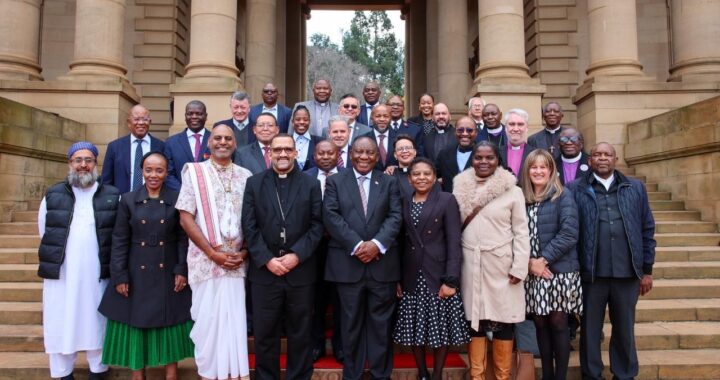
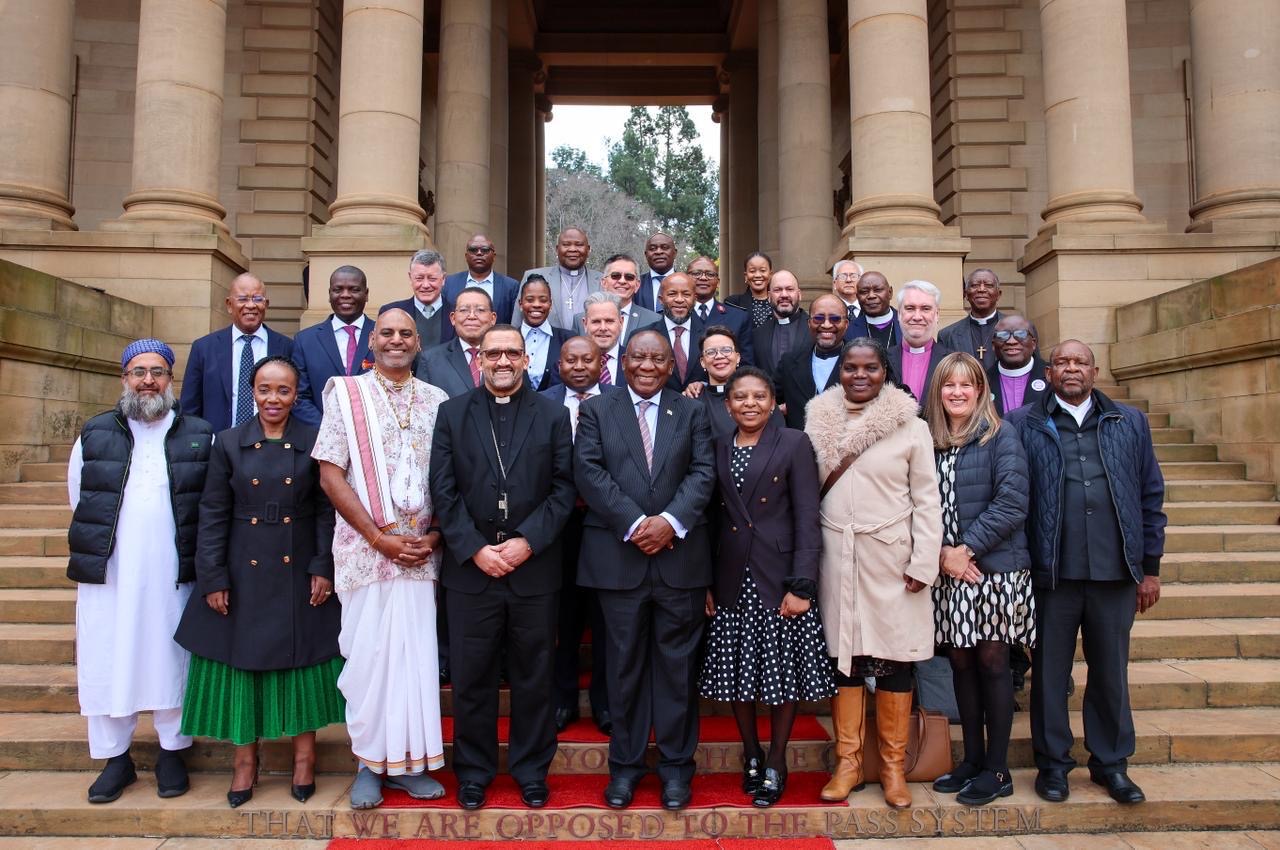
Yesterday, 17 June 2026, Archbishop Sithembele Sipuka, as president of the Southern African Council of Churches (SACC), addressed President Cyril Ramaphosa on the issue of aggression and violence against African foreign nationals. Below is his opening address. Above is a photo of the delegation, taken in front of the Union Buildings in Pretoria.
OPENING ADDRESS
South African Council of Churches
Engagement with His Excellency President Cyril Ramaphosa
On Aggression and Violence Against African Foreign Nationals
Your Excellency, President Cyril Ramaphosa, allow me first, on a personal note, to express my sincere gratitude for the kind letter of congratulations you sent upon my appointment as Metropolitan Archbishop of Cape Town. It arrived and was received with much warmth. I am settling in Cape Town and getting used to the new work.
I am grateful, on behalf of the leaders of our member churches gathered here, that you have received us on a matter that has weighed heavily on our hearts. We do not come to lecture, Mr President. We come as pastors who have been distressed by what they have witnessed across this land, and who believe that when the Church and the State walk together in good faith, a way forward can be found.
What Has Moved Us to Seek This Meeting
Your Excellency, we have watched with profound disquiet as fellow human beings — regardless of how they came to be in our country — have been hunted down, harassed, violated, their livelihoods destroyed, and their lives threatened unless they leave. This has happened, in the main, to our fellow Africans. It is inhumane. It is a violation of ubuntu. And it is an affront to human dignity, which derives not from a passport but from being created in the image of God.
We have addressed our congregations through a Pastoral Letter, reminding our people of the Scriptural injunction: “The foreigner residing among you must be treated as your native-born. Love them as yourself, for you were foreigners in Egypt.” We thank you, Mr President, for your own address to the nation on 7 June.
Hearing the Anger — Without Excusing the Violence
Mr President, we do not condone the actions of those who inflict pain on foreign nationals, and we have written strong words to them in our Pastoral Letter. Yet we hear and understand the frustration beneath their anger. Many who march worship with us on Sundays. They are people who feel abandoned — who experience the collapse of basic services, who live under the weight of unemployment, and who feel that government has been slow to hear them. Their concerns about porous borders, unlicensed trading, and unsafe goods are not imaginary, and those who raise them deserve to be heard with respect. But a real grievance, as we have told them, does not make a violent remedy right.
The Elephant in the Room
Mr President, if tomorrow every African foreign national were to leave this country, our problems would still be with us. The lack of basic service delivery would persist. Unemployment would remain. The insecurity and the drugs would remain. Because the cause is not the foreigner. The cause is the elephant in the room. In isiXhosa we say ukufa kusembizeni — the problem is in the pot itself.
That elephant is an education system that does not equip our young people to create work for themselves. It is the corruption that has hollowed out our institutions and collapsed the services on which communities depend. It is businesses that exploit foreign nationals for cheap labour to avoid paying fair wages — something you yourself noted in your address to the nation. To blame the stranger is to let these true culprits escape scrutiny.
The Failure of Law Enforcement
We are disturbed, Mr President, by consistent reports that law enforcement has turned a blind eye to much of what has unfolded, with inaction that in some cases amounts to silent complicity. Communities meant to be protected have been left to fend for themselves, while those who take the law into their own hands operate with impunity. The enforcement of law is the work of the state, not of mobs. We ask that it be enforced consistently and without favour — against those who commit violence, and equally against those in authority who look the other way.
The Exploitation of This Crisis
We are also disturbed by indications that some politicians are making of this humanitarian crisis an opportunity for political gain — using inflammatory rhetoric and manufactured panic not in the service of communities, but in pursuit of political advantage. We call on all political leaders, across all parties, to refuse to trade in the suffering of human beings.
The Timing of the Response
Your Excellency, we acknowledge your address to the nation with appreciation, but it came when things had already been allowed to get out of hand. Church leaders who gathered on 2 June brought testimonies of some two thousand affected families in KwaZulu-Natal alone, hundreds displaced, families without food, shelter, medication, or access to chronic treatment. The response must be early, not late, and it must be sustained. The commitments you have announced regarding border management, immigration administration, and labour law enforcement now require urgent, visible implementation. Announcements without follow-through restore no one’s confidence.
What This Is Doing to Our Country
Mr President, it was not so long ago that we ourselves were the ones at the door, and the African continent received us. Several African countries have already reacted with indignation to what they are seeing — and who can blame them? We risk returning to the isolation with which we were viewed during the apartheid era. And we must ask: who benefits when Africans turn upon Africans? Let us not be made instruments of any such division.
What We Are Asking of Government
Mr President, we ask that the response to this crisis be swift, visible, and sustained. That law enforcement do its plain duty and that complicity within the police service be investigated. That the true causes of our communities’ pain — unemployment, corruption, failing services, and poor border management — be addressed with the seriousness they deserve, because until they are, this anger will boil over again. That the war against lies and misinformation be waged with urgency — we commit to doing so in our own congregations. That political leaders who exploit this crisis be called to account. And that together we work toward a human, lawful, and procedural framework for managing the presence of foreign nationals — one that upholds their dignity, applies the rule of law to wrongdoers of every nationality, and reflects the constitutional democracy we fought to build.
Mr President, the stranger at our gate is not our enemy. Not so long ago, we too were strangers, and the continent received us. Let this conversation be the beginning of a better and more just way forward.
Archbishop Sithembele Sipuka
President, South African Council of Churches
Archbishop of Cape Town
Thanks for speaking out on the scourge of violence against foreigners.
Of what is happening is inhuman as long the President is against foreign nationals the way he addressed it to the nation it like poring fuel in the fire also causing hatred to each other we are all Africans and people didn’t choose to be here the situation forced them through politics,The way to resolve this issue to speak with President of Zimbabwe and call for free and fare election please may Almighty intervene on what is happening in Zimbabwe people are suffering because of few individuals misusing resources of the Country for their gain and becoming rich while majority is suffering and now being chase from neighboring countries on the other hand Zimbabwe Gorvernment is destroying house of which people built for their family really people don’t even know what to do or go this is really not good people are really confused of this situation please intervene through Our God and our mother Mary we pray everyday for better Zimbabwe to go back peacefully not this way it’s not easy we really don’t know where to start SA was becoming our home for many family also have adopted culture of SA some have children born and going to school here by doing this the family will reunite and being separated this will destroy future for many families who have bonded through this country hope they will get better solution to resolve this than to chase another Africa from Africa to where please hope this will head in patient and kindness very much worried
I fully agree with you Archy Bishop of Cape Town.I urge the government which is led by the President to deal with the common cause of this anger by South Africans because people can see that the authorities do nothing to those Foreigners who are committing atrocities like selling drugs to our children,violent crimes like killing innocent people human trafficking of you girls and children etc
This is a welcome statement. Like how apartheid when declared a heresy led to its demise, xenophobia and afrophobia must be declared a heresy. Both are rooted in hate for our fellow human beings. It is time not to talk of our fellow African brothers and sisters, documented or not, as foreigners, not even the biblical reference ” strangers”. It diminishes the goal of seeing SA as an extension of a great continent.
I would really appreciate it if change could come soon over our beautiful country “RSA! Especially with all the fighting going on.
We will always be african brothers and sisters of our continent. Let peace and love be a blessing for our foreign brothers and sisters make it a reality Mr President!
An excellent letter. Congratulations Archbishop Sithembele for responding to these blatant xenophobic attacks. It appears only a minority is supporting these attacks on our foreign brothers and sisters as exemplified by the turnout of only 30 people at the March organized. Let’s continue to support ubuntu – we are people through other people.
Thanks for this message. It is inspired in the hearts of our religious leaders who have de hearts and minds fixed in God’s love for humanity and at the same time in the suffering of the people who more suffer among all. Those who were obliged to leave their countries in order to survived. No for free choice.