RE-COMMITMENT MASS WITH THE PERMANENT DEACONS
OF THE ARCHDIOCESE OF CAPE TOWN
03 May 2026
Archbishop Sipuka
Readings:
Acts 6:1-7 | 1 Peter 2:4-9 | John 14:1-12
Today’s first reading was not chosen because I was going to celebrate this Mass with you. The liturgical calendar simply placed Acts 6:1-7 for this day. In my view, this is not a coincidence but providence because this passage is nothing less than the founding moment of the order of Deacons.
On the very first occasion that I celebrate the Eucharist with the permanent deacons of this Archdiocese, the Church places before us the story of how the diaconate began, the crisis that occasioned it, the qualities sought in its first members, and the mission it was created to serve. I did not arrange this. But I receive it as a gift, and I take it seriously because I believe in providence.
Let me narrate the situation. The early Church is growing, and with growth comes complexity. The Hellenist widows are being overlooked in the daily food distribution. They are a minority. They are vulnerable. The apostles face a genuine dilemma where the community needs the ministry of service, but they cannot abandon the ministry of the Word and prayer to provide it. Their solution is inspired: “Select from among yourselves seven men of good standing, full of the Spirit and of wisdom.” Seven men are chosen, hands are laid on them, and the result is immediate: “The word of God continued to spread; the number of disciples increased greatly.” That is where you come from.
It is with this story in mind that I want to say thank you to you, dear Deacons.
You are established men with professions, responsibilities, and families who need you. You could easily have given the Church the minimum; you could have been privately devout and coasted along without serious public commitment. Nobody would have blamed you. But you did not do that. You chose to be publicly known as men dedicated to the service of God in the Church. The witness of a married man, a father, a husband and a professional who has freely chosen to be ordained and to serve, is a witness the Church needs desperately and cannot manufacture by any other means. Thank you for your example in your families. Thank you for your public commitment. Thank you for being here.
As I meet you today for the first time as your Archbishop, and inspired by today’s reading, I would like to share with you about your order of Deacons and what it means for us today. Before I speak about what the founding of your order means for us today, however, let me say one word about prayer, because without it, nothing else will take root, and this applies not only to you but all of us, me included.
When the apostles explain why they need others to take on the ministry of service, they say: “We will devote ourselves to prayer and to serving the word”. Note that prayer comes first. Everything we do in the Church, every act of service, every homily, every hour of Caritas work, every conversation with a struggling couple, flows from our relationship with God, or it flows from nothing. The deacon who has not prayed is the deacon who is merely busy. The deacon who prays is the deacon through whom Christ acts. Guard your prayer. Guard it as you would guard your health, because without it, everything else eventually runs dry.
With that as our foundation, let me explain what the founding narrative of your order suggests: namely, the three ministries that speak directly to our situation in Cape Town and South Africa today.
Ministry One: Social Cohesion
The crisis in Acts 6 is not merely logistical. It is a crisis of belonging. The Hellenists, a cultural and linguistic minority, feel overlooked within the community. The apostles listen, acknowledge the failure; they do not defend themselves or explain the need away. No, they act without delay and with great wisdom, appointing people from within the aggrieved community itself, because those people know the needs and sensitivities of their own people in ways that outsiders cannot.
So, what we see in the foundation of the order of Deacons is a social, cultural, linguistic dissonance and poverty of social cohesion, something I cannot read without thinking of our own country.
Twenty-seven years after the end of apartheid, South Africa remains profoundly divided, with no sense of patriotism, even as we are civil and polite to each other; we are a society deeply divided. The apartheid geographical boundaries continue to separate us, and centuries of our separation embedded in our DNA makes us unable to relate in a real way and to be comfortable and caring for each other. Suspicion and prejudice about each other continue to characterise us, and sometimes surface in ugly ways.
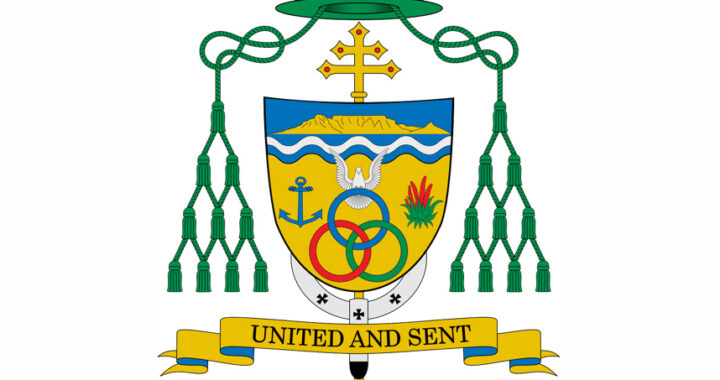
And this state of our being as South Africans manifests itself also inside the Church. When somehow, we are forced to come together, otherwise for the most part we choose not to come together, though we are all Catholics, we do not know how to be with each other because we carry guilt, anger, prejudice and ignorance about each other. In cosmopolitan dioceses like Cape Town, this lack of cohesion manifests in the conspicuous absence of some sections of the Catholic population from diocesan events and in an unwillingness to learn, speak, and sing in one another’s languages. For this reason, my episcopal motto is United and Sent, because unity is not merely a human aspiration but a direct wish of the Lord, “that they may all be one, (John 17:21). And as St Paul reminds us, in Christ, “There are no more distinctions between Jew and Greek, slave and free, male and female.” (Gal 3:28).
The founding moment of your order is a story about a community that faced cultural and political fracture and chose inclusion. You are embedded in families, workplaces, and neighbourhoods across this Archdiocese, crossing lines that clergy in presbyteries often cannot cross. The providence of this reading seems to be saying something about your particular calling to be ministers of the unity this country so desperately needs. There is no quick fix to this centuries-long challenge of division in our country but given that your order was founded amid this problem, I ask you to join me in helping resolve this lack of cohesion.
Ministry Two: Caritas
The diaconate was born at a table of distribution, in response to people who were hungry and overlooked. The word diakonos means servant, someone who ensures that those with nothing are not left with nothing. That is your foundation and the beating heart of what you are.
I have heard about Caritas of the Archdiocese. What I have not yet heard is how much the permanent deacons are involved in its work. I look forward to our conversation to better understand that, because your involvement in Caritas is not optional. It is the most natural expression of who you are and what you were ordained to be because your order was founded to respond to the needy.
And yet the diaconate is not confined to Caritas. Look at Stephen – one of those original seven appointed to serve at the table. He became so compelling a preacher that his opponents “could not withstand the wisdom and the Spirit with which he spoke”, and he became the first martyr of the Church. The Spirit in him could not be contained at the table.
So affirming that your foundation lies at the table of distribution, of charity and service, do not ever think that you are exempt from proclaiming the Word because your foundation is service. Stephen was appointed to serve tables, and yet the Spirit would not let him stay silent. The Word burst through the service, as it always does when a person is truly full of the Holy Spirit. It belongs to you, too.
I think of it as we think of the Trinity: creation is the particular work of the Father, redemption of the Son, sanctification of the Spirit, yet all three are involved in all three works. In the same way, Caritas is the defining and characteristic work of the deacon, while the proclamation of the Word belongs fully to you as well. Stephen shows us the two are never truly separate.
Ministry Three: Family
The seven were appointed because particular families were being overlooked – their most vulnerable members, the widows, were hungry and uncared for. And this connects directly to a third area where deacons have a particular and largely untapped calling: ministry to couples and families.
You are the married clergy of this Church. You know from the inside what marriage demands, what sustains it and what erodes it. There are couples in this Archdiocese struggling with communication, fidelity, the weight of raising children in this city, who would hear something from you that they might not quite hear from a celibate priest, because you speak from shared experience. You have lived the sacrament you are pointing them toward. I am keen to know how many of you are actively involved in family ministry, in marriage preparation, and in supporting struggling marriages. My instinct is that you should be more involved than you are right now, and I say that as an invitation, not a criticism.
I believe that our meeting this afternoon is designed by God, because through His Church, He has offered us a reading that speaks directly to the foundation of your order. Thank you for accepting this ministry that addresses the needs of our time: the need for social cohesion in a divided country, the need for organised and dedicated service to the poor through Caritas, and the need for accompaniment of couples and families, who are the bedrock of our society. The Church and this country need you. I am glad you said yes.
I come to you not with all the answers, but with a genuine conviction that your ministry is irreplaceable, and that in this Archdiocese, this city, and this country, the need for what you offer has never been greater.
The seven were chosen. Hands were laid on them. And the Church grew. May it be so again in our Archdiocese and our in country, through you.