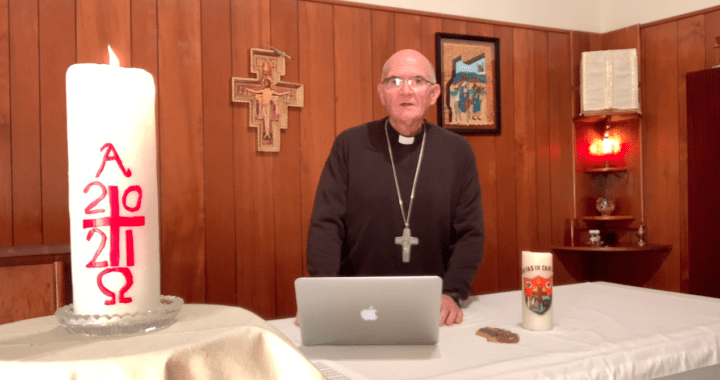
In this Year of the Eucharist in which we are invited to deepen our appreciation of the Eucharist in the life of the Church, each day for the next 30 days, members of the Archdiocese of Cape Town will offer reflections on aspects of the Eucharist.
In this reflection for Sunday, 9 May, Fr Shaun Addinall of St Augustine’s, Paarl, reflects on the meanings in the names we use for the Eucharist.
It is also available on the Archdiocese of Cape Town’s Facebook page and YouTube channel. Please share these daily reflections on your parish WhatsApp groups.
In this Year of the Eucharist in which we are invited to deepen our appreciation of the Eucharist in the life of the Church, each day for the next 30 days, members of the Archdiocese of Cape Town will offer reflections on aspects of the Eucharist.
In this reflection for Saturday, 8 May, Bishop Sylvester David OMI reflects on the Eucharist as Source and Summit of the Christian Life.
It is also available on the Archdiocese of Cape Town’s Facebook page and YouTube channel. Please share these daily reflections on your parish WhatsApp groups.
Auxiliary Bishop Sylvester David offers his prayer and reflection for the people of the Archdiocese of Cape Town for today, Friday 7 May 2021, during this time of the Coronavirus pandemic. It is also available on the Archdiocese of Cape Town’s Facebook page and YouTube channel. Please also see below the text of his reflection, primarily for the deaf.
Friday Reflection 7 May 2021. John 15:12-17.
The verse prior to this passage introduces our text and links it to the preceding verses. It states that Jesus spoke these things to us so that his joy may be in us and our joy be complete (John 15:11). The two verses prior to that informs us that Jesus has loved us just as the Father has loved him and encourages us to remain in his love by keeping his command, just as he remains in the Father’s love by keeping the Father’s command. Obedience to the divine word thus becomes the means of our union with God. [Please readJohn 15:9-17 slowly and prayerfully].
In John 15:11 Jesus says: “These things I have spoken to you, that my joy may be in you, and that your joy may be full” (John 15:11). The term for ‘spoken’ indicates a permanent and effective utterance that could never be cancelled. With Christ, his declaration is permanent. All that is needed is for it to be actualised in the hearts of believers. In John 15:12 we are encouraged to love one another as Christ has loved us. Jesus explains what this love means by saying that there is no greater love than to lay down one’s life for one’s friends (John 15:13). All through these verses the word for love refers to the self sacrificial love demonstrated on the cross. There are four words for love in Greek and the Cross represents the highest form of love. It is totally selfless and is characterised by humility. This is how we are called to imitate Jesus.
Jesus says quite directly that we are his friends if we do what he commands (John 15:14). This is an invitation to examine how we carry out his commands, and to make sure that we follow Jesus for what he said and not for what he did not say. There are too many false claims made in His name as some tend to forget that Jesus does not want admirers, but followers. He did not come to form a fan club but wanted disciples who could imitate him (cf. John 13:15).
He then gives us the model of perfect friendship. “… I call you friends because I have made known to you everything that I have learned from my Father” (John 15:15). Let’s consider this for a while. We tend to use the word “friend” rather loosely. But are our “friends” really friends or are they acquaintances? If we take the model which Jesus gives, then only those to whom we reveal our true selves are our friends. Yes! During the pandemic we have to wear masks – but in authentic relationships such as marriage, spiritual direction, etc. what is needed is for us to be un-masked so that the true self can be known. Jesus calls us friends because he has made known to us all that the Father has shown him. All that the Father has shown him is Jesus himself, complete and unadorned. It is only when we can reveal our true selves to others that they can become our friends.
It is not a sin not to have as many friends as we would like to have. While we are called to be neighbourly and show friendship and consideration to others, in real life (if it is real!), we will have varying degrees of association – with many acquaintances and also some friends. Why do I say this? Simply because all of us, in our daily communications, function between revealing and concealing. For example, we do not say in public what we say to our spiritual directors, spouses, lawyers, doctors, confidantes and special friends. This does not in any way mean that we should not be friendly and neighbourly to those who cross our paths. It simply means that we should be prudent.
The passage ends with Jesus indicating that he has given us these commands in order that we may love one another. This love that he speaks of is based on our union with him and is, at the same time, our means of imitating him. There are many subtle indications in the passage which show this. It is good to know all that but the ultimate aim of the text, with all its nuances, is that our hearts should expand so that the love of Christ may expand in us – this is a thought that comes from St Eugene de Mazenod. All our relationships, whether they reveal or conceal, ought to make Christ more loveable to those we encounter. This is called spreading the Gospel.
Let us pray: Father thank you for the love which you show us in the life, death and resurrection of Jesus. Give us the grace to imitate him more closely in his offering of himself for others. Help us to give practical example to this love by becoming servants to each other. We make this prayer though Christ our Lord. Amen. [Blessing].
Bishop Sylvester David OMI VG: Archdiocese of Cape Town
In this Year of the Eucharist in which we are invited to deepen our appreciation of the Eucharist in the life of the Church, each day for the next 30 days, members of the Archdiocese of Cape Town will offer reflections on aspects of the Eucharist. In this first reflection for Friday, 7 May, Archbishop Stephen Brislin reflects on the Eucharist and Christian Initiation and how the Eucharist was instituted by Jesus at the Last Supper.
It is also available on the Archdiocese of Cape Town’s Facebook page and YouTube channel. Please share these daily reflections on your parish WhatsApp groups.
Archbishop Brislin’s presentation is available here in English and Sesotho.
Archbishop Stephen Brislin offers his prayer and reflection for the people of the Archdiocese of Cape Town for today, Wednesday 5 May 2021, during this time of the coronavirus pandemic. It is also available on the Archdiocese of Cape Town’s Facebook page and YouTube channel. Please also see below the text of his reflection, primarily for the deaf.
Welcome to this week’s reflection. We continue in Easter time, waiting expectantly for the Feast of Pentecost, the coming of the Holy Spirit on the Apostles. We remain conscious of the Resurrection of Christ and the new life that we already live through him. To him be all glory, honour and power! For the Reading I have taken the entire Gospel of today’s Mass; it is from St John’s Gospel (John 15:9-11).
At that time: Jesus said to his disciples, “As the Father has loved me, so I have loved you; abide in my love. If you keep my commandments, you will abide in my love, just as I have kept my Father’s commandments and abide in his love. These things I have spoken to you, that my joy may be in you, and that your joy may be full”.
Let us pray:
O God, by whose grace we have been made just, although we are pitiable, we have been made blessed. We ask that you will stand by your your works and by your gifts, that those who have been justified by your gifts may not lack the courage of perseverance. We make this prayer, through our Lord Jesus Christ, your Son, who lives and reigns with you in the unity of the Holy Spirit, God for ever and ever, amen.
The prayer is based on the Collect of today’s Mass. It is always imperative to pray for the courage of perseverance, because we face many struggles that can discourage us and cause us to give up. There are also many things that attract us but which can lead us away from our faith. The Evil One is always active in the world and we need to be vigilant not to be deceived by him and never to give up our hope, which lies in Jesus Christ alone.
In the Reading from St John, Jesus urges us to “abide in his love”. The Sacrament of the Eucharist is a visible and material manifestation of his love for us. We need the Eucharist, for it strengthens us and gives us the courage to continue on the journey of faith. Before receiving Communion, the priest raises the consecrated Host and Chalice and invites us to, Behold the Lamb of God, behold him who takes away the sins of the world. These are words spoken by St John the Baptist when he saw Jesus approaching (John 1:29) – he pointed people to Jesus who is the source of God’s forgivenss, and who comes to us as the innocent Lamb of God. The people at Mass respond, also by using words from the Gospel: Lord, I am not worthy that you should enter under my roof; but only say the word and my soul shall be healed. These beautiful words are based on the words of the centurion at Capernaum who sought the healing of his servant (Matthew 8:8). They are words of deep faith and confidence in Jesus. Before receiving Holy Communion, we too say these words expressing our faith in the healing power of Jesus who comes to us in the Eucharist, even though we are unworthy. Some may find the concept of “enter under my roof” rather strange because it is buildings that have roofs, not people. But as I have said many times, the whole of the Eucharistic celebration is Biblically based and it is appropriate to emulate the faith expressed by the gentile centurion. It is not meant to be convey a physical roof. These words call to mind Jesus’ words in the Book of Revelation (3:20): Here I am! I stand at the door and knock. If anyone hears my voice and opens the door, I will come in and eat with that person, and they with me. In responding to the priest’s invitation, Behold the Lamb of God, we respond by inviting the Lord who “knocks at the door” to enter in, that we may enjoy the fellowship with him that is captured in the phrase, I will come in and eat with that person.
This brief excgange between the priest and people is a beautiful and deep expression of appreciation for the Eucharist. There is the call to “behold” – to look to Jesus and to always have him before our eyes. “Who takes away the sins of the world”, an acknowledgement of Christ’s mission and his sacrifice for the forgiveness of sins and for the salvation of people. The humble expression of unworthiness on the part of those who will receive Communion indicates their gratitude to Jesus whose blood was shed to wash away our sins, and gratitude to the greatness of God who blesses us with a great gift of new and everlasting life that is to be found in the Eucahrist – Jesus said to them, “Very truly I tell you, unless you eat the flesh of the Son of Man and drink his blood, you have no life in you”(John 6:53). We receive life by receiving the Eucharist. And again, in beholding Jesus, it is to Him that we turn for the healing we long for, the everlasting healing of mind, body and soul – the wholeness of the life promised to us. In his words, I have come that they may have life, and have it to the full (John 10:10). It should be noted that the priest responds with the people, “Lord I am not worthy….”
All who approach to receive Communion are encouraged to make a sign of reverence before receiving Communion – this can be a bow, genuflecting or making the sign of the Cross. Whatever sign you make should not be an obstacle to those coming after you in the Communion line, nor should it be exaggerated. Some prefer to receive Communion on the tongue, others on the hand. Of course, in these Covid times we are not able to receive on the tongue due to the possible danger of transmitting infection to others. However, I would appeal to those who prefer to receive on the tongue not to deprive themselves of Holy Communion at this time, but to accept receiving on the hand until such time as things change. Jesus has commanded us to “do this in memory of me”, and he has blessed us with his Body and Blood to give us life. Let us not cut ourselves off from that life.
In some countries, such as South Africa, it is common (in non-Covid times) to receive Communion “under both kinds” – however, this is far from universal. The Church’s teaching is that receiving Communion under any one kind is to receive both the Body and Blood of Jesus. Thus, receiving only the Consecrated Host is perfectly acceptable and it constitutes both the Body and the Blood. A few, perhaps who are gluten intolerant, may receive only from the Chalice, and they too receive both the Body and Blood of Jesus.
Let us now pray for God’s blessing:
The Lord be with you R/ And with your Spirit
Bow down for the blessing:
Hasten to the aid of your faithful people who call on you, O Lord, we pray, and graciously give strength in their human weakness, so that, being dedicated to you in complete sincerity, they may find gladness in your remedies both now and in the life to come, amen
May Almighty God bless you, the Father and the Son and the Holy Spirit (+), amen.
Pope Francis declared the Year of St Joseph, running from 8 December 2020 to 8 December 2021. This is a rare opportunity for us to focus on this great man who is often described as “standing in the shadows”. Joseph becomes our guide to visit the important moments of the life of Mary and the childhood of Jesus. Though operating in obscurity, Joseph leads us to a deeper understanding of Church, work, family, husband, fatherhood and prayer as we delve into some important aspects of his life. Every time we do we this have a refreshing encounter with who we are as Church in the world today. As this is also the Year of the Eucharist, Benediction forms an integral part of our devotions.
This year is an invitation by Pope Francis to celebrate St Joseph. It is an opportunity that the Church and the faithful should appropriate fully.
Deacon Arthur Johannes presents the third of the monthly reflections. It is titled: St Joseph the Worker and will be livestreamed to Good Shepherd Bothasig YouTube channel on 4 May 2021 from 7.00-7.30 pm.
Auxiliary Bishop Sylvester David offers his prayer and reflection for the people of the Archdiocese of Cape Town for today, Friday 30 April 2021, during this time of the Coronavirus pandemic. It is also available on the Archdiocese of Cape Town’s Facebook page and YouTube channel. Please also see below the text of his reflection, primarily for the deaf.
Reflection for Friday 30 April 2021: Luke 1:26-38; Acts 1:12-14
Today the Church holds up for us a shining example of unconditional obedience to the will of God. Today we celebrate Mary, Mother of Africa. This feast gives us a good opportunity to see what Scripture says about her. In the first reading from the Acts of the Apostles (Acts 1:12-14), Mary is portrayed as being with the Apostles and others in the upper room, engaged in “continuous prayer” (Acts 2:14). The original text indicates a persistent prayer of petition, talking to God, and also that the community at prayer were of one mind in all of this. In short, Mary engaged with the praying community and it was on this community that the Holy Spirit descended on the feast of Pentecost.
The Gospel passage is familiar to many of us. It is the text of the Annunciation and gives us some important clues as to the character and person of Mary. The appearance of the Angel and the ensuing dialogue indicates a prayer experience. The Gospel of Luke presents Mary as a woman of prayer. In fact several times in the first two chapters of Luke, Mary who was completely overshadowed by the Holy Spirit (Luke 1:35), is described as having profound prayer experiences. She listens to, and dialogues with, the angel. She surrenders to what God wants of her. When she visits Elizabeth – and Elizabeth, who was also filled with the Holy Spirit (Luke 1:41), confers the title “mother of my Lord” on her – this after pronouncing Mary to be the “most blessed among women” (Luke 1:42-43). She recognised Mary as being blessed because of her belief in God (Luke 1:45). Mary’s response to all this is to quote scripture as she sings an Old Testament canticle (1 Samuel 2:1-10). This is known to us as the Magnificat (Luke 1:46-55) and is said or sung at the Church’s Evening Prayer every day.
But back to the text of the Annunciation. The attentive Bible reader will notice that the announcement of the conception of the Saviour took place in an obscure place. It was not where the holy city was. It was in Galilee, which means circle, and in the time of the New Testament it was called “the circle of the Gentiles” because of the number of Gentile neighbours. The people of Jerusalem used to frown on the people of Galilee because they mixed with these neighbours. Mary came from a remote place believed to be unholy because of Gentile presence. Our next hint at Mary’s lowliness is given in the way in which the narrative is conveyed. Mary is first of all described as a virgin – someone whose opinions would not have counted. We are told that she was betrothed to a man named Joseph and his ancestry is immediately given (Luke 1:27). And only then are we told that the virgin’s name was Mary. It is clear in the original text that Luke conveys this as an afterthought. No ancestry is given. Why this omission when, prior to this and also after this, Luke does not hesitate to indicate the ancestry of the women in his story? Earlier in this chapter we are told that Elizabeth was a descendant of Aaron (Luke 1:5) – hence of priestly descent, and in the next chapter we are told that Anna was the daughter of Phanuel of the tribe of Asher (Luke 2:36).
This strategy is simply to remind the Bible reader of how God works. God constantly shows a preferential option for the lowly. The small of this world are deemed great by God. There is a whole litany of this in the Bible. In the Cain and Abel story God chose the offering not of the firstborn but of the younger son (Genesis 4:4-5 – where the original text is constructed in such a way so as to draw attention to this). In Genesis 27, Jacob the younger son received the blessing of the eldest. Joseph was belittled by his siblings but raised by God (Genesis 37ff). When Jacob blessed his grandsons – the sons of Joseph called Ephraim and Manasseh (Genesis 48:13-22), he crossed his arms in blessing so that the younger received the blessing of the first born and vice versa. When David was appointed King, his own father and brothers did not realise that it was David who God had chosen (1 Samuel 16:6-13). They minimised him to such an extent that they did not even recognise that he was not with the group. And later on, how did the young shepherd slay the might of the Philistine army? He did it with the toy of an Israelite boy – a sling (1 Samuel 17:48-51). Yes indeed – God chooses the humble.
This continues into the New Testament where the humility of Jesus is amply testified. It reached its highpoint when he washed the feet of his disciples (John 13:1-15). Constantly during his ministry he taught that the humble shall be exalted and the mighty brought down (Matthew 23:12; Luke 14:11). This is how God works. And how the humble virgin of Nazareth is chosen. In a recent address to an interfaith gathering Archbishop Brislin defined humility as allowing God to be God. This is exactly what Mary did – she allowed God to be God.
The greeting offered by the angel is an important Old Testament greeting and is used very sparingly (Zephaniah 9:9). It is only used for the daughter of Zion. The words rendered “Hail Mary, full of grace” (Luke 1:28) is a popular way of translating the text. The original is complex and reads: “Rejoice, you having-been-graced-by-God” (Luke 1:28). Some observations from the syntax of Luke 1:28 are helpful: firstly, “rejoice” (which shares the same root of “having-been-graced”) refers to a joy so intense that it cannot be contained. This is why Pope Francis starts “Evangelii Gaudium” with these words taken from Zephaniah 9:9. The second observation is that only God could have graced Mary. The Greek language has mechanisms to show this. The third observation is that now that she has been graced she could never be un-graced. This intervention by God is permanent and irreversible. This is why Mary declares that “all generations” will call her blessed because God has looked on her lowliness and has done great things for her (Luke 1:48). This is what happens when one allows God to be God. The fourth observation is that being graced is an essential part of who Mary is. If she was not graced she would not be Mary the mother of Jesus – she would be someone else.
The text is rich and filled with surprises – but our reflection must be brought to a close.
Let us pray: Lord, when the angel left Mary after her acceptance of your will, he did not stop his work. He continues to come to the followers of Jesus daily to ask if we could make room for your word in our hearts. We are called to offer our poor human flesh to become tabernacles of your word. Help us to respond as generously as Mary did. We ask this through Christ our Lord. Amen. [Blessing].
Bishop Sylvester David OMI VG: Archdiocese of Cape Town
Archbishop Stephen Brislin offers his prayer and reflection for the people of the Archdiocese of Cape Town for today, Wednesday 28 April 2021, during this time of the coronavirus pandemic. It is also available on the Archdiocese of Cape Town’s Facebook page and YouTube channel. Please also see below the text of his reflection, primarily for the deaf.
As we begin to feel the chill in the air during the nights, we are reminded again that the season is changing and winter will soon be upon us. The cycle of the seasons is indicative of the cycle of life – things emerge and things pass. The Covid 19 pandemic will also, one day, fade away. In the meantime we need to persevere in patience and consideration for the health of others. Welcome to this reflection. In the Gospel of today’s Mass (John 12:44-50) we hear these words from St John:
At that time Jesus cried out and said, “He who believes in me, believes not in me but in him who sent me. And he who sees me sees him who sent me”.
Let us pray:
O God, life of the faithful, glory of the humble, blessedness of the just, listen kindly to the prayers of those who call on you, that they who thirst for what you generously promise may always have their fill of your plenty. We make this prayer, through our Lord Jesus Christ, your Son, who lives and reigns with you in the unity of the Holy Spirit, God for ever and ever, amen.
The prayer was taken from the Collect of today’s Mass. We believe in Jesus, but what is it that we believe about him? We too “see” Jesus (not physically, as in the past, but with eyes of faith). Who is it that we see? The most graphic, astounding and unsettling image of Jesus Christ is Jesus hanging on the Cross – indeed a stumbling block and folly to many people (cf. 1 Corinthians 1:23). We believe in a Christ who is broken and beaten, a Christ whose life is poured out from his body.
After the sign of peace at Mass, we enter into the third action essential to the Celebration of Eucharist. You will recall the four necessary actions: Jesus took bread, he gave thanks, he broke it and he gave it to his disciples. It is a pity that the breaking of the consecrated bread at Mass, referred to as the fraction rite, is not better emphasised as it is integral to the celebration. At the Last Supper, Jesus broke the bread and shared it among his apostles. This symbolic action manifests the Eucharist as a time of sharing and participation. So important was this action that the early Church referred to the ritual which we now know as the Mass, as the “breaking of the bread”. It symbolizes, and brings into reality, unity among believers who share the one Body of Jesus Christ, and thus become one body among themselves. It is a unity achieved through the broken Body of Jesus and his outpuring on the Cross for the reconciliation of sinners.
It is our communion with each other, as well as communion and participation in the life of Jesus Christ. It expresses the fact that we do not attend Holy Mass as individuals, nor do we only pray individually. We attend Mass as a community, and the prayers of Mass are our community prayers. It is really important and essential for us to understand this, especially for those who live in big cities. Cities can become an anonymous way of life, a place of isolation and loneliness. Living as a community in a city requires a lot more effort than, for example, if you live in a small village. Our baptism has called us into the Church commnity, into the family of God. This is why attendance at Sunday Mass is central to our Christian vocation. There are some who say something like, I can pray at home; or perhaps, there are so many distractions at Church I can concentrate better at home. We cannot, and must not, separate ourselves from the Church community – we are required to play our part. Presence in the community is part of keeping “the Sabbath holy”. The gathering together as the community of believers is in itself a central part of our prayer and worship. Where two or three are gathered together in my name, I will be present among them[1], Jesus taught us.We can also remind ourselves that Jesus regularly attended Synagogue prayer. In these times of Covid, when many people are not able to attend Mass through no fault of their own, they should join a livestreamed Mass and make a spiritual communion, and in that way unite themselves to the community.
As the presiding priest breaks the Bread, the Agnus Dei is said or sung. It calls on Jesus, the “Lamb of God” (John 1:29,36) who has conquered sin and death (1 Peter 1:18; Revelations 5:6, 13:18). The priest also breaks off a little of the Bread and places it in the chalice containing the Blood of Christ, saying quietly May this mingling of the Body and Blood of our Lord Jesus Christ bring eternal life to us who receive it. This action is called the fermentum and dates back to the early Church as a sign of communion between the Bishop with the local churches. In those days, not everyone could take part in a papal Mass. Parts of the Bread from the Pope’s Mass was broken off and then taken to the local churches so that they would not feel separated from communion with the Holy Father. This was similarly done by Bishops to express community with local churches.[2] The Pope is the symbol of communion in the Universal Church, and a mark of our catholicity is to be in communion with the Pope, just as much as the Bishop is the symbol of communion in the local Church (the diocese) and we always act in communion with him.
After the fermentum the priest will quietly pray a prayer of preparation before he receives the Body and Blood of Christ. It is an opportunity for each person to say a private prayer of preparation, so that we can receive Communion worthily. One of the two prayers the priest says personally is, Lord Jesus Christ, Son of the living God, who, by the will of the Father and the work of the Holy Spirit, through your death gave life to the world, free me by this, your most holy Body and Blood, from all my sins and from every evil; keep me always faithful to your commandments, and never let me parted from you. After this prayer he will genuflect (or make a deep bow) and then raises the consecrated host and wine for all to see saying, “Behold the Lamb of God…” – but more of this next week.
Let us now pray for God’s blessing:
The Lord be with you R/ And with your Spirit
Bow down for the blessing:
Heavenly Father, so often we can negelct to recognize the presence of your Son Jesus in our lives at times of brokenness and emptiness, and we neglect to see Christ in the brokenness of others. Fill our hearts with faith, compassion and mercy so that we will never doubt your guidance and that we may look kindly and generously on those in need of our help. Through Christ Our Lord, amen.
May Almighty God bless you, the Father and the Son and the Holy Spirit (+), amen.
Please Like and Subscribe to this page/channel prior to Saturday to easily gain access to the funeral stream. Please note that to ensure the best quality of stream, we are advised that you should watch on YouTube.
Please note that the procession at the graveside will also be broadcast afterwards.
Bishop Sylvester David will give be giving a talk on the last phase of the RCIA, Mystagogia, during a Zoom meeting on Monday April 28 at 7 pm (log on is available 15 minutes before). The Zoom link ID is 873 9557 6567. No password is required.
RCIA groups can have a discussion within their groups if they wish to do so after the input.