Please find attached details of this most exciting event planned for the beginning of the new term.
[gview file=”http://adct.org.za/wp-content/uploads/2014/10/Meditation-15-16Oct.pdf”]

Please find attached details of this most exciting event planned for the beginning of the new term.
[gview file=”http://adct.org.za/wp-content/uploads/2014/10/Meditation-15-16Oct.pdf”]

Below please find a letter and poster giving details of the upcoming Holy Childhood Mass
[gview file=”http://adct.org.za/wp-content/uploads/2014/10/Poster-Holy-childhood.doc”] [gview file=”http://adct.org.za/wp-content/uploads/2014/10/Holy-CHildhood-2014-Letter.doc”]

Below are some pictures of the SPRED annual Mass of Thanksgiving which was celebrated by chaplain Fr Mark Foster at St John’s, Maitland on Saturday 20 September 2014
SPRED (Special Religious Development) is a catechesis specially designed for the disabled.
Photos by Stephen Engelbrecht.


Below are some pics of the final session of the 2014 Catechetical Formation Programme at Lansdowne and Koelenhof.


Please find below daily reflections for the National Week of the Older Person, 29 September – 5 October
[gview file=”http://adct.org.za/wp-content/uploads/2014/09/National-seniors-week.pdf”]

Attached is an introductory video for Ecclesia: Brave New Church for Youth and Young Adults.
Themes:
1. Fearless Love
2. Renew the Face of the Earth
3. An Instrument of Transformation
4. If you suffer, I suffer
5. Sisters and brothers on a journey
5. We are all Africans.

Monsignor Anthony Seba (14 November 1912–2 September 2014) died peacefully at Nazareth House, Cape Town and was buried from Christ the King Church in Pinelands on 9 September 2014. The Requiem Mass was presided over by Archbishop Stephen Brislin, and Fr Hugh O’Connor preached the homily. The funeral was well attended by priests of the Archdiocese, religious and parishioners alike.
Below are some pictures of the funeral, plus an account of his life and ministry.


Monsignor Anthony Seba was the sixth and last born child of Hanna (John) and Miriam (Mary) Seba. He was born in Cape Town on the 14th of November in 1912 and was baptised in St Mary’s Cathedral and later started schooling with the Cabra Dominican Sisters at St Mary’s Convent School and continued his schooling with the Marist Brothers. After making his First Communion he became an altar server and served until he was accepted by Bishop Bernard O’Riley for studies to the priesthood. In 1932 he was sent to Rome to begin his studies at Propaganda Fide. Fellow students at the time included Mgr Con Lynch and Owen Cardinal McCann.
In 1938, after the completion of his studies and ordination, he returned to Cape Town as the first South African of Lebanese descent to be ordained a priest. Bishop Francis Henneman SAC, of whom he was very fond, sent him as curate to Holy Cross in Nile Street under Mgr J.Galvin.
After serving at Holy Cross for two years he was appointed as one of the curates at St Mary’s Cathedral and for the next 10 years he ministered to the people of St Mary’s, serving also as the first official Catholic Chaplain to the Roeland Street Jail.
In 1950 he was appointed as Parish Priest of Sts Simon and Jude in Simon’s Town as well as Chaplain to the Royal Navy and later the South African Navy. While in Simon’s Town he witnessed the transfer of the Naval Base from British to South African Naval Command. During the time of forced removals under the Group Areas Act he appeared before the Group Areas Board testifying against forced removals in Simon’s Town receiving a letter of appreciation from the Chairperson of the Simon’s Town Group Areas Liaison Committee for his efforts.
After leaving Simon’s Town he went to Pinelands. He arrived there in 1960 and took up residence at St Joseph’s Sanatorium, now St Vincent Pallotti Hospital. The Pinelands Church at this time was in essence a Mass Centre served from the hospital. According to Mgr Seba it was only when he moved out of the hospital that the parish really came into its own.
During his time in Pinelands he oversaw the building of the hall, the purchase of the presbytery, the beautification of the grounds with the establishment of a garden planted with many of the trees and shrubs that are mentioned in the Holy Scriptures. He oversaw the renovation and extension of the church building. He secured the use of a piece of land in front of the Church which was developed into a parking area for the parishioners.
In 1977 he went to Rome to attend the canonisation by Pope Paul VI of St Charbel Makhluf, a relative of his. This brought him great joy and happiness as well as a tremendous sense of pride.
While in Pinelands he played an active role in civic, community and religious life of the suburb. In recognition of his long service to the people of Pinelands a public bench was dedicated in his honour by the municipality. The bench, which stands outside of the parish hall, is inscribed: “Donated by the people of Pinelands in recognition of service by Rev Anthony Seba, Parish Priest of Christ the King, Pinelands, 1960-1988.” During his time in Pinelands he also acted as an examiner for the junior clergy and wrote some sub leaders for the Southern Cross as well as book reviews. On occasion, with special permission, he also celebrated the Tridentine Mass.
After twenty eight rewarding years in Pinelands it was back to the seaside, for in 1988 he retired to St Theresa’s in Camps Bay. In 1992 he was made a Prelate of Honour and added the title Monsignor to his name, recognition by the Church of his long years of faithful service. He spent three happy years there but with failing eyesight it became time for another move. In 1991 he moved back to St Mary’s Cathedral. He was warmly welcomed there by Mgr Donald de Beer, and though in retirement Mgr Seba continued to assist the parish when necessary. It was at St Mary’s in 1998 that he celebrated his 60th anniversary of ordination to the priesthood while Mgr Andrew Borello was Administrator. At this celebration, quoting Marcus Aurelius he said, ”Think of what you have, rather than what you lack. Of what you have select the best. And then reflect how eagerly you have sought it, if you did not have it”. Of his priesthood he had this to say, “I cannot imagine what my life would have been without it. It has given me, even on a human level, all that I prize most. It has allowed me to develop as me. It has been an enrichment of my mind, my heart and personality as nothing else could have done. I believe that without it my life would have been an arctic waste”.
In the years that followed he moved into frail care at Nazareth House. He lived through the pontificates of Popes Pius X, Benedict XV, Pius XI, Pius XII, John XXIII, Paul VI, John Paul I, John Paul II, Benedict XVI and and died during the time of Pope Francis. In terms of the local Church he has lived under the following bishops of Cape Town: John Rooney, Bernard O’Riley, Francis Hennemann SAC, Owen Cardinal McCann, Stephen Naidoo CSsR, Lawrence Henry and Stephen Brislin. In March 2014 on the Feast of St Joseph he celebrated his 76th anniversary of priestly ordination.
Mgr Seba died peacefully in his room on 2 September 2014 at Nazareth House.
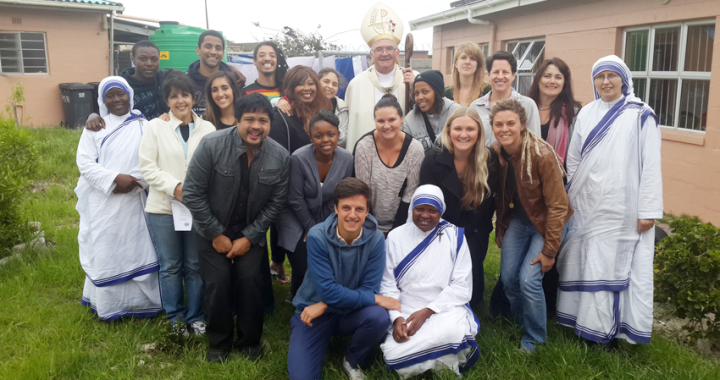
On Saturday, September 6th, Archbishop Brislin celebrated a Feast Day Mass with the Missionaries of Charity at their convent in Khayelitsha. Below are some photos of the occasion, kindly sent by Jessica Dewhurst, co-ordinator of the Umoya Project on behalf of the Edmund Rice Network. Archbishop Brislin also visited the project.


Below are some pics of the launch of our new Ecclesia season: Brave New Church, held at Springfield Convent, Wynberg on Saturday 30th August 2014. After registration at 08.30 the day began with a brief introduction to the structure of the day, an opening liturgy (with liturgical dancers), and an introduction to the new season by Archbishop Brislin, Mgr Andrew Borello and Fr Charles Prince. After tea attendees broke into four groups for training: parishes, youth, junior catechesis and senior catechesis. After lunch Fr Chris Chatteris gave the keynote address, after which there was a commissioning and blessing.


by Raymond Perrier.
It’s a bit unusual to start these weekly commentaries with a quote from the Communist leader Mao Tse Tung. But it seemed appropriate since in these weeks – for those of you who live in cities and have not noticed – South Africa is entering into springtime and soon, all across the country, a thousand, if not a million, flowers will bloom.
The botanic gardens and flower fields of this country, especially places like Kirstenbosch or the Namaqualand, are internationally famous and draw tourists from around the world. They come to admire the fynbos, succulents, restios and proteas that locals take for granted. Botanists divide the world into 5 plant kingdoms: 4 of them cover whole continents but the 5th and the smallest – the Cape Floristic Kingdom – is entirely contained within South Africa. It contains 9,000 species, more than 2/3 of them unique to here. In fact, the Cape Peninsula alone boasts more plant species than the whole of Great Britain!
So as well as being proud of the animal life of this beautiful country, let us also take time to appreciate, admire, preserve and thank God for the plant life. It is unfortunate that too often we treat plants as a landscape (to be overlooked), an inconvenience (to be eradicated), or a commodity (to be harvested) or a decoration (to be thrown away when a bit limp). Of course flowers are wonderfully decorative but they are also essential to the eco-system – not a backdrop but the backbone of all ‘higher’ forms of life (ourselves included).
For me an important aspect of botany is the magic of diversity. Though I am a lazy gardener, I have had the privilege of spending time with some serious and inspiring plants-people. I am constantly in awe of their ability to see varieties of colour where I only see green and to identify minute but critical differences between plants and elements of plants that to me all look the same. Diversity in plant life is not just impressive – it is essential.
Plants need each other and the variations in their forms of reproduction, the way they use water, the kind of soil in which they prosper and the times of year that they bloom are all part of an intricate mechanism of inter-dependence and mutual support. Anybody would think that it had all been designed! This diversity is then threatened by external forces (usually human) who mess up some aspect by polluting the water or spoiling the land. One of the greatest threats is when humans introduce an ‘alien’ species (something from outside the system) which actually undermines diversity because it overpowers the balance of plant life that is already there.
The Bible is full of metaphors drawn from plant life – from the lilies of the fields to the jonquils blooming in the desert. What lesson can we draw from botanic diversity? That difference is not just to be tolerated but encouraged? That respectful balance between different opinions, different ways of life, different cultures, different spiritual journeys is something that benefits everyone? That when any one form becomes over-bearing or seeks to suck life out of the system, we have to intervene and tame it or eradicate it? That sometimes things blossom and prosper when they are cared for – and sometimes when they are left alone? I leave you to draw your own lessons – and thus give you a perfect excuse to find time in the next few weeks to sit silently outdoors and smell the roses, and the proteas, and the zantadeschias, and the strelizias, and the ……