Thank You, Thank You, Thank You…

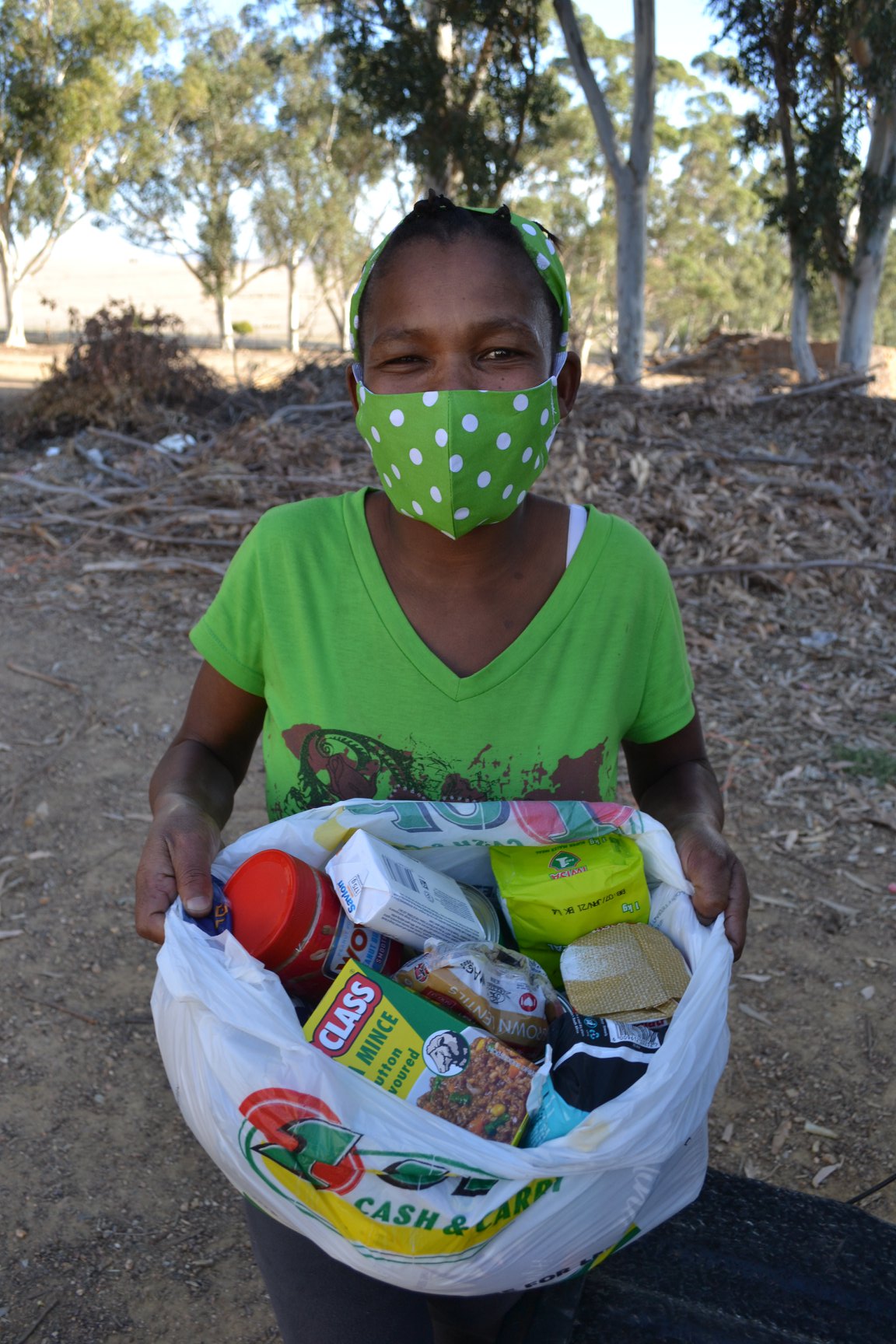
When you are used to having very little, anything more makes you feel like you have won the lottery. That is how we felt when the Archdiocese of Cape Town donated another 75 food parcels, besides the 80 that they have donated a few weeks ago, to help feed rural farm families on Middelpos and surrounding farms. The joy, gratitude and much appreciation were visible in the eyes of the families who received it. The families clung onto the bags as if it was the most precious possession and the children could not wait to take out the food! Their smiles broadened each time they showed others a can of food or a packet from the food parcel. We drove home knowing that amongst all the sadness and suffering, this precious gift of a food parcel may be an answer to many prayers. A million thank yous to Archbishop Stephen Brislin, Bishop Sylvester David, Eugene Jackson and everyone else involved in working so hard to raise the funds and pack the bags and donate it to our rural farm families in an effort to help fight the spread of coronavirus, restore human dignity and give hope. 

To date, with all the donations that we have received in our bank account and via our givengain facebook campaign, we have distributed a total of 251 food parcels to help 1 305 vulnerable children, women and elderly people on Middelpos and surrounding farms. 

In addition to this, the children and their mothers donated 900kgs of fresh vegetables, more than 100 self-made cloth masks, jam and pickled vegetables worth nearly R80 000 to the farm families. They hope to continue to grow food and make masks to have surplus to start selling to the public in the near future. If you would like to order cloth masks or donate a fresh veggie bag to a farm family, please let us know. 

A million thank yous to everyone who has so far supported our food campaign. 

The struggle is far from over! We are still 8 food parcels short to finish the first round, then we start again, till such time that things are easier for the families. Please send us a donation to help support our food campaign on rural farms by clicking on the link below or requesting our bank details. Thank you so much.

Link

Prayer and Reflection by Bishop Sylvester David OMI

Auxiliary Bishop Sylvester David offers his prayer and reflection for the people of the Archdiocese of Cape Town for today, Friday 15th May 2020, during this time of the coronavirus pandemic.

It is also available on the Archdiocese of Cape Town’s Facebook page and YouTube channel. Please also see below the text of his reflection, primarily for the deaf.

Reflection during lockdown: Friday 15th May 2020.
Why is it important to adopt protective measures against the spread of the Coronavirus pandemic? There are a few considerations. 
First and foremost it makes sense to do so. Suppose notice was given that there was a deadly snake on the loose in a certain park – apart from professional snake handlers, which of us will go near that park, let alone venture into it? Considering the nature of snakes, there is more chance of the snake disappearing than our being bitten. With the Coronavirus, there is a far greater chance of becoming infected if we do not take precautions such as hand washing, social distancing, and the other measures recommended for this time. 
Sadly, looking around us, some are foolish enough to ignore the recommendations. In places where there is hardly any space between dwellings, where there is no clean water, etc. like in some informal settlements one can understand this, but what about our shopping malls which according to our health ministry is where most infections take place? Perhaps it is the fact that we cannot see a microbe which is only a fraction of the size of a hair follicle that makes us careless. A deadly snake we can see – sometimes a bit too late I agree, but Covid-19 we cannot see until it is too late. 
In all this we must remember that we take precautions for two reasons – the first is to protect our own lives and well being; and the second is to protect those with whom we come into contact. In nthis regard we will do well to bear in mind that although we may be symptom free, we could still be carriers. Just going out whenever we feel like it can bring the virus into our homes. This is particularly serious where senior citizens and vulnerable persons such as diabetics are involved. The command by God: “Thou shall not to kill” has never been revoked – it is still valid. That we should not kill means that we ought to promote life. The Church is pro-life. This has always been the case. Being pro-life is far more that protesting against abortions. Apart from our anti-abortion stance which is absolutely necessary, we have to commit to promoting life all through the life span – we must exist so that people with whom we associate have life and have it to the full (cf. John 10:10). In that way we imitate Jesus.
In the book of Genesis the first question to fly into the face of the Creator comes from the murderous Cain: “Am I my brother’s guardian?” (Genesis 4:9). Throughout the rest of the bible, the answer is a resounding “YES” – we are our brother’s keep and our sister’s keeper.
In the Gospel reading for today’s Mass taken from John 15, Jesus reminds us that we are meant to love the neighbour. Using the example of his own life he says that no one can have greater love than to lay down his or her life for the other (cf. John 15:13). This is the love we are meant to imitate. The word used for love indicates a love that is self sacrificial. It is more than a nice feeling and certainly does not ask: “what’s in it for me?”. This love is for the good of the other and for the benefit of the other. It is meant to protect them from infections even if it that makes me uncomfortable and restless. This is the high calling of the followers of Jesus – to love as he himself loved.
Let us pray: Father, your Son gave us an example of what love is all about. His love was the opposite of selfishness and personal gain. Help us to imitate him in such a way the good news may be lived out through each of us. We make this prayer through Him who gave his life so that we could live. Amen.

The Future of Ministry in a Digital World

Have you registered for our upcoming training on ministry in a digital world? It is aimed at all leaders in ministry and will focus on why there is a need to continue our ministries online during and after this pandemic, the various options available for us to utilise, including for the data-conscious, potential content and best practices as well as important hospitality and etiquette tips.

This will be presented by our Youth Chaplaincy Team members Fr Charles Prince, Dominique Yon, Leonardo Sforza and the youth and training lead at Alpha, Nqobile Ngcobo.

Prayer and Reflection by Archbishop Stephen Brislin

Archbishop Stephen Brislin offers his prayer and reflection for the people of the Archdiocese of Cape Town for today, Wednesday 13 May 2020, during this time of the coronavirus pandemic.

It is also available on the Archdiocese of Cape Town’s Facebook page and YouTube channel. Please also see below the text of his reflection, primarily for the deaf.

Thank you for joining me for this reflection and I wish all God’s blessings on you and your loved ones.

Let’s start with two verse from today’s Gospel, from St John chapter 15:

Make your home in me, as I make mine in you.
As a branch cannot bear fruit all by itself,
but must remain part of the vine,
neither can you unless you remain in me.
I am the vine,
you are the branches.
Whoever remains in me, with me in him,
bears fruit in plenty;
for cut off from me you can do nothing.

Let us pray:

Heavenly Father, open our hearts and minds to your life-giving Spirit, that we may always make ourselves available to you, willing to do your will. Make fruitful our works, Lord, that we may serve the Kingdom of Heaven and bring your light and grace into the world.

We make this our prayer, through our Lord Jesus Christ, who lives and reigns with you in the unity of the Holy Spirit, one God for ever and ever, amen.

The beautiful teaching of Jesus in St John’s Gospel, that he is the vine and we are the branches, reminds us that our God does not live in the heavens, beyond our reach. He is close to us, his life is in us and our lives are in his. We are united with him, truly in communion with him, a closeness that defies all human understanding. It also reminds us that we are called to bear fruit and to bear it plentifully – but we bear fruit, not by our own power or merit, but because his life is in us. That is why, separated from him, we are not able to bear fruit because we have become “dead wood”, useless and only fit to be cut off. It is therefore imperative for us always to preserve the communion we have with God, even when we fall into sin we hasten to restore our relationship with God through confession and repentance, because we know without him we can do nothing.

Today we also celebrate the feast of “Our Lady of Fatima”. Mary, perhaps even without hearing this teaching of Jesus, knew that the without the life of God within her she was nothing. Thus, in her great song of rejoicing, the Magnificat, she says: “he has looked on his servant in her lowliness, henceforth all ages will call me blessed”. It is an acknowledgement that her blessedness comes not from herself, but because God has “looked on her in her lowliness”. Mary, like John the Baptist and the Apostles in the Acts of the Apostles, never tried to draw attention to herself. Thus, she says at the wedding feast of Cana: “do what he tells you”.

Similarly, her apparitions at different times in the course of history, have always called on people to turn once again to God. The different events of her life are not about her and her merits but about God. The Immaculate Conception is not a teaching about Mary, but about God and his grace and salvific action – Mary is immaculately conceived by Joachim and Anne, not because she merited it, but by God’s will, pre-empting Jesus’ death and his bestowal of grace upon his people; the Assumption into heaven is a practical teaching and consequence of Jesus’ resurrection and the promise of resurrection for all those who believe in him, accomplished by God’s power. She is referred to as “the tabernacle of the Most High” at Ngome. The tabernacle is the place of God’s special presence, reminiscent of Jesus’ teaching in St John ch 14 v 23:  “Anyone who loves me will keep my word, and my Father will love him, and we shall come to him and make a home in him”.  It is by God’s mercy that she was the tabernacle of the Most High, and by his mercy we too are meant to be tabernacles of the Most High God – just as we are the branches of the one vine.

Mary’s apparitions at Fatima, just over a hundred years ago, offer no new revelation for salvation, despite the “secrets” of Fatima. All revelation is contained in the Scriptures and is accessible to all – educated or not educated, rich or poor, black or white, of whatever nation, people or language. We may not fully understand that revelation, we certainly need to deepen our appreciation of it and it will always be a mystery until the end of time, but it is available to all people not only a few  “enlightened” or specially chosen people.

This, again, is testified to in the apparitions of Mary – she chose to appear to the poor man Juan Diego at Guadaluppe, and to the young children of Fatima, not to the great and “mighty”. As we celebrate the apparitions of Fatima we are reminded how these three young children suffered so bitterly because of what they had witnessed. But they, like Mary, never sought a following or to be praised by people. They pointed to the message of the Virgin Mary which, in turn, pointed people to her Son Jesus. Two of the children, Francisco and Jacinta died soon after the visions. Francisco in 1919 at the age of 10, and Jacinta at the age of 9 in 1920 – a hundred years ago. And they died because of the great pandemic of the time, the flu that began in 1918 and lasted two years, killing an estimated number of between 17 and 50 million people. They died in pain and great suffering, but they never lost their faith in God and their trust in the beautiful Lady who had appeared to them. They looked forward to heaven where they would be completely united with God – the God who is the vine and allows us to be the branches.

How much we need to learn from these young saints in these difficult times – we need to learn to be people of deep faith and hope, facing the future not with dread but with confidence and an unshakeable belief of God’s life in us, and our lives in God. We seek their intercession as we face a very similar crisis in the world today, we seek the intercession of Our Lady of Fatima. But we are also reminded that just as we ask them to intercede for us, so we should intercede for others, praying for them and holding them in prayer. We bear fruit by both praying for them and reaching out to them in solidarity, offering consolation, support and comfort.

Let us now pray together:

Hail Mary, full of grace, the Lord is with thee, blessed art thou amongst women and blessed is the fruit of thy womb, Jesus. Holy Mary, Mother of God, pray for us sinners now, and at the hour of our death, amen.

Saints Francisco and Jacinta                                  R/  Pray for us

Let us now pray for God’s blessing:

The Lord be with you                                          R/ And with your Spirit

Bow down for the blessing:

Heavenly Father, through the intercession of our Blessed Mother and the saints Francisco and Jacinta, we pray for your blessing upon us, our loved ones, the Church and the world. Help us to turn to you, Lord, in this time of crisis, always trusting through faith the promises your Son has made to us. Keep us always as living branches of the true vine, that we may be in communion with you and with each other, and that your life and grace may always be present in us.

We Make this prayer through Christ Our Lord, amen.

May Almighty God bless you, the Father and the Son and the Holy Spirit (+), amen.

Laudato Si’ Week

In preparation for Laudato Si week, a conference was scheduled at the Christian Brothers Centre, Stellenbosch on Saturday 9 May 2020, but due to the Coronavirus Pandemic, an online conference replaced it.  Christian Brother Terry Dowling gave a very valuable and informative presentation (see below). 

There is still time to sign up to Laudato Si week and we really hope that Br Terry’s presentation will motivate many to do so.  

In order to make headway in spreading this very critical and relevant information to every human being right now, we need to have a team that can collaborate and ensure that everyone hears about what and how they can do to make their own lives easier and improve the state of the world now and for future generations.  The coronavirus is yet another anthropological event creating more hard challenges for everyone but mostly poor and marginalised communities. 

Pope Francis’ homily today portrayed that we need a kind of ‘peace that looks to heaven’, and the only way we will find this real peace is in how we live now.  Brother Terry brings this together incredibly well in his presentation through explaining the presence of Eucharist in our lives today.  

How wonderful is it that we now have Laudato Si’ week, made possible through digital technology, to participate fully in the retreats, workshops, activities, and prayer?  The present coronavirus troubles and tribulations are at the centre of the week-long event. 

Laudato Si’ Week helps us reshape the world that will arise after the pandemic has passed. The present crisis is an opportunity to start anew, and to make sure that the world that arises after this crisis has passed is sustainable and just.

Please sign up for Laudato Si’ Week by clicking the link above so we can grow our South African awareness and really can make life better for all, where the eventual living in peace and harmony in a just, sustainable world is a very possible reality.

Here is Br Terry’s presentation on Eco Spirituality, from the Christian Brothers’ Centre, Stellenbosch.

Mother’s Day reflection by Bishop Sylvester David OMI

Mothers’ Day. Reflection for 10th May 2020.

This is based on a reflection I wrote a year ago in San Antonio. I think it is still applicable and have made a few adaptations.

On 10th May we will celebrate Mother’s day. The commercial aspects which many of us like to thrash, actually do have their place as we owe it to our mothers to shower and even to lavish them with gifts. But there are also other important aspects which need to be reflected on. There are four levels of motherhood which need to considered.

Firstly, the biological level: This is how God intended the promise he made to Abraham to be fulfilled. When our mothers conceived, God raised them up to be his dialogue partners in bringing new life into the world. When they suffered for us, made sacrifices for us and endured pain on our behalf, they actually participated in the life of Christ because the pattern of his life was seen in theirs. I wish every mother a happy day – may your union with God through the gift of motherhood continue to give you strength. Closely associated with the care our biological mothers have given us, are those motherly persons who show care to us, sometimes even beyond the call of duty. And so we rejoice in the “relational” motherhood which is so life-giving. I think particularly of care givers in orphanages.

The second level is the consideration of the Church as mother. The Church is truly our mother, having given birth to us through the womb of the baptismal font and nourishing us on the breasts of the new and the old testaments. She pours oil on our wounds when we are ill and forgives us when we sin. She feeds us with the finest bread and gives us the best wine to drink. In short she cares for us from before birth (no abortion); until after death in her daily prayers for the dead – a thoroughly scriptural practice which many Christians seem to ignore. Right now she faces a crisis as many of her children are either directly or indirectly affected by Covid-19. We must pray for the Church that she fulfils her mission in the best way possible during this time of shutdown.

The third level considers the gift Jesus gave to his disciples from the Cross. In John’s gospel when Jesus was on the cross and seeing the disciple he loved, he said to his mother: ‘This is your son’ (John 19:26) and to his disciple he said: ‘This is your mother’ (John 19:27). The original text makes it clear that the mother-son relationship between Mary and the disciple is personal. In other words, Mary is truly the mother of the disciple and the disciple is truly the son of Mary. It is very interesting that the disciple is unnamed – meaning that he resembles every disciple of Jesus. John 19:27 makes it very clear that on that very day, the disciple took her into his home. Now we are all disciples of Jesus. The question is this: have we taken her home? How have we responded to the last words of the Master?

The fourth level of motherhood that we need to consider is that of mother earth. We have not only neglected this mother; we have actively abused her. It costs the earth to sustain us and we have choked it with plastic and other non-biodegradable materials. We have damaged the ecology to such an extent that life will not be sustainable in a few years. To the extent that we nurture this mother, she will in turn nurture us. This is urgent and we have no choice. We were created to be stewards of creation and thus far we have failed miserably.

I wish you a meaningful reflection on the biblical faith of the Church with respect to the gift of motherhood. LJC et MI.

+Sylvester David OMI
Cape Town