Archbishop Stephen Brislin will launch the Synod in the Archdiocese of Cape Town from St Mary’s Cathedral at 10.00 a.m. on Sunday 17 October 2021. The Mass will be livestreamed to the Cathedral and to the Archdiocese of Cape Town Facebook page.
Author Archive: Archdiocese of Cape Town

Synod Prayers in isiXhosa & Afrikaans
Attached below are Synod prayers translated into isiXhosa by Fr Nkululeko Qokolo, parish priest of Bellville; and into Afrikaans.

Get your FREE Southern Cross
Dear all,
Attached please find our FREE extra digital issue of The Southern Cross to mark our first birthday as a magazine, and 101st as a Catholic publication. It includes some of our best articles over the past year. I hope you will enjoy it, whether you see the magazine for the first time, or catching up with articles you might have missed or forgotten about.
Unlike with our monthly issues – and October is out now and November is coming soon – we invite you to share this extra edition widely, to anyone you know. Please spread it widely: we want people to see that The Southern Cross is a great read, and hopefully they’ll want to see more of it.
HOW TO SHARE?
1. Forward this letter to anyone who you think might be interested in receiving it. If you’re not sure, you could send the link www.scross.co.za/sc-first-year to your contacts, with an invitation to get their free extra issue there.
2. Share the issue on all your social media: WhatsApp, Facebook, Twitter, Instagram. If you don’t want to upload the document, you can give the direct Download link:
https://app.box.com/s/u2fd1dddmqik2k5y7wkp1lsdn09235kz
If possible, please encourage people to share the document and/or links to it widely as well. And ask them to subscribe at www.digital.scross.co.za/subscribe.
Let’s make it go viral!
Thank you for your support,
Günther Simmermacher
Editor
The Southern Cross
Southern Africa’s Catholic Monthly Magazine

Prayer and Reflection by Bishop Sylvester David OMI
Auxiliary Bishop Sylvester David offers his prayer and reflection for the people of the Archdiocese of Cape Town for today, Friday 15 October 2021, during this time of the Coronavirus pandemic. It is also available on the Archdiocese of Cape Town’s Facebook page and YouTube channel. Please also see below the text of his reflection, primarily for the deaf.
Reflection for 15 October 2021. The Synod
This first paragraph might seem a bit technical but it will resolve itself in the end. In my reflection dated 17 September 2021 I made reference to a self sufficient Church. This is what I penned: “In 2013 prior to becoming Pope Francis, Cardinal Jorge Bergoglio SJ referred to the serious sin of self referentiality and called it a “theological narcissism”. Self referentiality is a technical term referring to an extreme form of independence which screams out that we need nobody and that no one can teach us anything”. In his subsequent utterances the Pope condemned the tendencies toward self referentiality which leads to “spiritual sickness”. Did Pope Francis generate this term? No it is part of his Jesuit heritage. The term was used by Henri de Lubac SJ – one of those gifted persons who enlightened the mind of the Church in preparation for the Second Vatican Council. De Lubac had recourse to the thinking of the Apostolic Fathers who spoke of the “mysterium lunae” – literally, “the mystery of the moon”. This refers to the fact that the Church has no light of her own but reflects only the light of Christ. The Apostolic Fathers used the analogy of the Sun and the Moon to illustrate the relationship between Christ and the Church.
There are two modes of being Church. One is a highly organised group of people who work out their plans and expect the Church authority to put a stamp of approval on it. This is a Church to whom dialogue is foreign and at times even unnecessary. It is efficiency oriented and wants to get things done. Another type of Church is a group of struggling people who gather around the Cross and try to work out their future from that perspective. Because the Cross symbolises struggle, pain and the victimising of the innocent; many try to bypass it. But if as Pope Francis says that the Church is a “field hospital for the wounded” then we will have to adopt more of the second mode and learn to listen and to dialogue. We will have to listen to the struggling people symbolised by the struggles represented by the Cross, and from there work out what is the next right step.
Some years ago I was Parish Priest at a place which had many outstations around the foothills of the Drakensberg Mountains. The place was extremely cold in the winter. A well placed parish in Durban made an annual donation of blankets to one of the outstations. I once received a call from the person in charge of the project asking me to make arrangements to fetch and distribute the blankets. I thanked the person and while chatting suggested that it will be good if he and his friends could meet the people who benefitted from their kindness. He readily accepted the invitation and a few days later came up in a few vehicles. We went to the place and was welcomed by the poor people of that area who set out for their guests many delightful things to eat and to drink. They gave the best they could give. The guests stayed longer than planned but were deeply moved by the exchange and from getting to know and to see how other people lived in their rural settings. That friendship and exchange continued for many years.
In his address over the weekend the Holy Father cautioned against not being open to new ways of doing things: “‘We have always done it this way’ (Evangelii Gaudium, 33) and it is better not to change. That expression – ‘We have always done it that way’ – is poison for the life of the Church. Those who think this way, perhaps without even realizing it, make the mistake of not taking seriously the times in which we are living. The danger, in the end, is to apply old solutions to new problems. A patch of rough cloth that ends up creating a worse tear (cf. Matthew 9:16). It is important that the synodal process be exactly this: a process of becoming, a process that involves the local Churches, in different phases and from the bottom up, in an exciting and engaging effort that can forge a style of communion and participation directed to mission.”
Consequently the first phase in the Synodal process is the listening phase. It runs from 17th October 2021 when the Synod will be launched in the Archdiocese until April 2022. At this time we ask all Parish Priests/Administrators, Religious Superiors, Lay leaders, and Institutions to facilitate “a listening”. Guidelines have been developed and these have been sent to the various constituencies in the Archdiocese.
I wish you well as we embark on this special journey together.
Let us pray:
We stand before You, Holy Spirit,
as we gather together in Your name.
With You alone to guide us,
make Yourself at home in our hearts;
Teach us the way we must go
and how we are to pursue it.
We are weak and sinful;
do not let us promote disorder.
Do not let ignorance lead us down the wrong path nor partiality influence our actions.
Let us find in You our unity
so that we may journey together to eternal life and not stray from the way of truth
and what is right.
All this we ask of You, who are at work in every place and time, in the communion of the Father and the Son, forever and ever. Amen.
Bishop S. David OMI
VG/Auxiliary Bishop: Cape Town

Moment of Reflection for the opening of the Synod in Rome
Please see this video, courtesy of Vatican Media, recording the “Moment of Reflection” on Saturday 9 October 2021 in the Synod Hall, in preparation for the opening of the Synod on Sunday 10 October 2021.
To watch only the Testimony by Dominique Yon, Youth Co-ordinator in the Archdiocese of Cape Town, fast-forward the video to 1hr 05min 30sec (by dragging the large red dot on the extreme left of the “timeline”).
To watch the Mass for the opening of the Synod by Pope Francis at St Peter’s Basilica on Sunday 10 October 2021, please go to this link: https://www.youtube.com/watch?v=wXmuPKvr3-E

Prayer and Reflection by Archbishop Stephen Brislin
Archbishop Stephen Brislin offers his prayer and reflection for the people of the Archdiocese of Cape Town for today, Wednesday 13 October 2021, during this time of the coronavirus pandemic. It is also available on the Archdiocese of Cape Town’s Facebook page and YouTube channel. Please also see below the text of his reflection, primarily for the deaf.
Welcome to today’s reflection. In this month of Our Lady, we pray especially for peace in our country and region. We are all too aware of the political violence, criminal violence, family violence and the violence against the most vulnerable. Let us never tire of praying for peace while, at the same time, striving to be peacemakers. And so we pray the prayer for peace in Southern Africa:
O God of justice and love, bless us, the people of Southern Africa, and help us to
live in your peace.
Lord, make me an instrument of your peace:
Where there is hatred, let me sow love;
Where there is injury; let me sow pardon;
Where there is discord, let me sow harmony.
Divine Master, grant that I may not so much
Seek to be understood, as to understand;
To be loved, as to love;
To receive sympathy, as to give it;
For it is in giving that we shall receive,
In pardoning that we shall be pardoned,
In forgetting ourselves that we shall find
Unending peace with others. We ask this through Christ Our Lord, Amen.
One of the themes of today’s First Reading (Romans 2:1-11), as with the Gospel (Luke 11: 42-46), is a warning against hypocrisy. St Paul asks whether the person passing judgement on others for the very things that he himself is guilty of, thinks that he will escape the Judgement of God. St Paul says:
Do you suppose, O man, that when you judge those who do such things and yet you do them yourself, you will escape the judgement of God? Or do you presume on the riches of his kindness and forbearance and patience? Do you not know that God’s kindness is meant to lead you to repentance?
There is often the temptation to take the “moral highground” which is a position of supposed superiority and judgement of others. We can see clearly the faults of others and hold them responsible for their mistakes and sins. It is much more difficult, firstly, to recognize our own faults, and secondly, to take responsibility for them. It is much easier for us to find excuses for our own sins and to downplay them, than it is for us to do so for others. In short, it is easier for us to see the splinter in our brother’s eye and never notice the log in our own eye (cf. Luke 6:41).
We can also be in a “comfort zone” of misunderstanding God’s compassion, mercy and forgiveness. It is true that in the past, at least in certain circumstances, there were those in the Church who preached “fire and brimstone”, and the proclamation of the forgiveness and love of God could be neglected. At the same time, there can be the temptation to proclaim God as an all-forgiving God who is abundantly rich in mercy and compassion in a way that presents a cheap and wimpish mercy, an “automatic” forgiveness. It is absolutely true that God is all forgiving and rich in mercy but we should never forget that the price of that forgiveness – the sacrificial death of Christ on the Cross. Repentance is offered to all people through the Cross. Repentance is the necessary requirement for forgiveness – his kindness and mercy demand conversion, a change of heart, turning to God and away from sin and embracing a new life, as Bishop Sylvester spoke of in his reflection last Friday.
The fact is, we cannot be ambivalent about sin, about what is right and wrong, even though we often face “grey areas” where we are not sure what the right thing to do is, we always try to do what is right in terms of our Christian values.. Jesus showed no ambivalence in the face of sin and was not afraid of denouncing sinfulness – a good example is the Gospel of today’s Mass where Jesus denounces the sinful hypocrisy of the Pharisees – Alas for you, because you are like the unmarked tombs that men walk on without knowing it. When Jesus teaches us, Do not judge, and you will not be judged, he is not saying that we should turn a blind eye to sinfulness and to evil in the world or that we should be indifferent when evil people cause immense suffering to others by using them as commodities. God is not insensitive and uncaring to those who suffer and who live in fear of their tormentors; he is not insensitive to those who are discriminated against and who suffer injustice. We cannot be indifferent, either, to sin in the world. Our mission is to be a beacon and light in the darkness, leading people to the hope we have in God’s love through repentance.
“Do not judge, and you will not be judged”, says Jesus (Matthew 7:1). We must recognise that “evil” and “sin” are not only things “out there”. They exist also within us and. Just as we can contribute to the growth of God’s Kingdom of love through small everyday deeds done with kindness, we can also contribute to suffering through small, everyday deeds, when we disregard the needs or feelings of others. In our own “bubble” we can cause suffering and pain to others. “Judge not lest you be judged” means that we need to examine ourselves honestly and to be conscious of the times when we sin against God and neighbour and, above all, to understand and accept how much we are in need of God’s mercy and grace for our own salvation. We cannot come to that awareness without deep, regular prayer and contemplation. It is when we are in communion with God that his light reveals to us how we too fall short of the glory of God (Romans 3:23) and how much we are in need of being saved.
Let us now pray for God’s blessing:
The Lord be with you R/ And with your Spirit
Bow down for the blessing:
Loving Father, we thank you for the high price paid for our forgiveness and redemption. Work through your holy people that they may be beacons of light and truth and so lead others to you, the eternal Truth. Through Christ, our Lord, amen. May Almighty God bless you, the Father, the Son and the Holy Spirit, amen.
Opening of the Synod in Rome
Attached below, please find two documents from the opening of the Synod in Rome – the address of Pope Francis for the opening of the Synod in the Synod Hall on Saturday 9 October 2021, and his homily at the opening Mass at St Peter’s Basilica on Sunday 10 October 2021.

Document on Human Fraternity
This livestreamed interfaith event on theological dialogue and practical ethics, hosted by the Catholic Church in Cape Town and the Ahlulbait Mosque in Ottery, took place at St Mary of the Angels Church, Athlone on 12 October at 7.30 pm. Presented by Fr Chris Clohessy (from Rome) and chaired by Fr Peter-John Pearson.
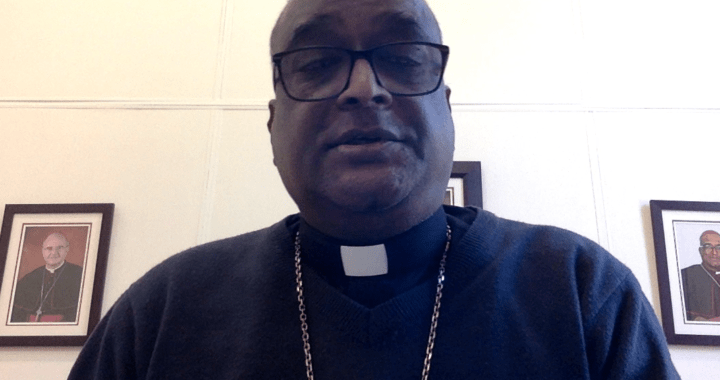
Prayer and Reflection by Bishop Sylvester David OMI
Auxiliary Bishop Sylvester David offers his prayer and reflection for the people of the Archdiocese of Cape Town for today, Friday 8 October 2021, during this time of the Coronavirus pandemic. It is also available on the Archdiocese of Cape Town’s Facebook page and YouTube channel. Please also see below the text of his reflection, primarily for the deaf.
Let us start by praying for the fruitfulness of the upcoming Synod.
We stand before You, Holy Spirit,
as we gather together in Your name.
With You alone to guide us,
make Yourself at home in our hearts;
Teach us the way we must go
and how we are to pursue it.
We are weak and sinful;
do not let us promote disorder.
Do not let ignorance lead us down the wrong path nor partiality influence our actions.
Let us find in You our unity
so that we may journey together to eternal life and not stray from the way of truth
and what is right.
All this we ask of You, who are at work in every place and time, in the communion of the Father and the Son, forever and ever. Amen.
Our preparation to meet our God. Joel 1:13-15, 2:1-2
Our first reading has a strong resemblance to the liturgy of the Word on Ash Wednesday. It comes from the prophet Joel which means “the Lord is God”. His father was Pethuel which means the “mouth or persuasion of God”. There is thus a strong insistence that God wants to convince us of something.
From the text it is clear that religious obligations have been neglected. In order to correct these matters a day of fast and repentance has to be proclaimed and no one is exempted from this. The whole nation, priests and people – in other words citizens of all ranks have to, in unison, turn towards the Lord. The scene presented in Joel 1:16 ff. is one of gloom with there being a shortage of what is essential for life. All told, the need for repentance is urgent.
Perhaps it is necessary to understand the concept of repentance. In the OT, the word used for repentance implies a turning away from sin and a turning towards God. In the NT it means a reorientation of one’s whole life. In the language of St Paul it is to become “a new creation” (2 Corinthians 5:17). It means embracing fully the call to follow Christ.
Fridays are normally reserved for attention to one’s inner being and many continue to practice some sort of abstinence on Fridays. In fact the Irish word for Friday literally means “The Fast”. Our morning prayer on Fridays contains the penitential psalm (Psalm 51) showing ones dependence on God’s mercy and asking for a humbled, contrite heart. The OT prophets show the true meaning of fasting. It is more than giving up some food – it is to show mercy to the needy. Is 58:1-16 is a well know passage which shows what a genuine fast is all about. In the Sermon on the Mount Jesus shows that real fasting is not so much about putting on a show. It is about showing integrity (Matthew 6:18). In fact according to Jesus one cannot be in relationship with God without fasting, almsgiving and prayer (Matthew 6:1-18). So almsgiving, the essence of a divinely approved fast, is an essential dimension of our relationship with God. Without it our fasting is not genuine and our religion will lack integrity.
This reading from Joel is a meaningful reminder to us to examine the worthiness – or otherwise, of our religious practices.
Prayer: Lord send us the Holy Spirit to help us worship you in spirit and in truth. We ask this through Christ our Lord. Amen.
Bishop S. David OMI
VG/Auxiliary Bishop: Cape Town
Opening of the Synod in Rome and Cape Town
Pope Francis will officially open the Synod on Synodality at the Vatican with the celebration of the Eucharist at Saint Peter’s Basilica on Sunday 10 October, preceded by a moment of reflection in the New Synod Hall on Saturday 9 October.
Please see the attached letter from Bishop Sylvester David OMI regarding the opening of the Synod in Rome, and in our Archdiocese.